AI Engineering Team Structure: Smaller Teams Win in 2026
Your AI rollout did not move delivery because your org chart is built for 2020. The fix: smaller teams, senior-weighted, fewer handoffs. Step-by-step inside.
Most engineering organisations are still structured for 2020. Large teams, heavy process, offshore leverage for cost. The tooling has changed. The org chart has not. And the gap between those two realities is where delivery goes to die.
AI did not just give developers better autocomplete. It changed which team shapes produce results. The companies running 2020 org charts with 2026 tools are the ones wondering why everything still feels slow, even though they adopted Copilot six months ago. The team is not slow because of the people. It is slow because the structure assumes a world where humans do all the work and cost arbitrage is the primary lever. That world is gone.
I've watched this play out across enough teams to see the pattern clearly. The ones who restructured around AI's actual economics are shipping faster with fewer people. The ones who bolted AI onto an unchanged org are spending more and getting less. The difference is not tooling. It is structure.
The 2020 Team Shape Optimised for a Problem That No Longer Exists
The standard engineering org of 2020 was built around a simple premise: building software is expensive, so optimise for cost and throughput. That meant large teams, because more engineers meant more output. It meant offshore leverage, because an engineer in a lower-cost market was cheaper per unit of production. It meant heavy process, sprints, standups, estimation rituals, detailed ticket workflows, because coordinating a large group of humans doing complex work required coordination infrastructure.
None of that was wrong at the time. If your primary constraint is that writing code is slow and expensive, headcount is your main lever. If your team is large, you need process to keep it coherent. If you are optimising for cost per feature, offshore arbitrage makes sense. The 2020 shape was a rational response to 2020 economics.
The problem is that those economics changed, and most org charts did not change with them. According to Google's research on AI-assisted development, engineers using AI tooling complete coding tasks 20-30% faster on average, with some categories of work seeing far larger gains. The production cost of software dropped. But the coordination cost of the org stayed the same, or got worse, because the org was sized for a different ratio of builders to output.
A team of 25 engineers with three layers of management, four ceremonies per sprint, and a two-week review cycle made sense when each engineer produced a modest, predictable amount of code per week. When each engineer, with AI tooling, produces two to three times that volume, the coordination infrastructure becomes the dominant cost. You are spending more time managing the work than doing the work. The structure is optimised for a bottleneck that no longer exists.
AI Changed Team Economics, Not Just Developer Speed
The common narrative about AI in engineering is that it makes developers faster. That is true but incomplete. The deeper shift is in the economics of what a team needs to produce results.
Before AI, there was a roughly linear relationship between headcount and output. Ten engineers shipped more than five. Twenty shipped more than ten, with some coordination overhead. The curve bent, but it was positive. Hiring was the primary lever for increasing throughput.
With AI tooling embedded properly, one senior engineer handles what previously required two or three. That is not a prediction; it is what I have seen in practice. The implication is not just "you need fewer people." It is that the type of team that produces results has fundamentally changed.
The old model optimised for labour cost. Hire offshore, get more hours per dollar, accept the coordination overhead as a necessary trade. The new model optimises for coordination cost. Every handoff, every approval gate, every status meeting, every context switch is now a larger percentage of total delivery time, because the production work shrank. Stripe's developer productivity survey found engineers were already spending over 40% of their time on non-coding work before AI adoption. When AI compresses the coding portion, that ratio gets worse, not better.
This means the teams that win are not the ones with the most engineers. They are the ones with the fewest handoffs. Fewer people, fewer dependencies, fewer coordination ceremonies, more ownership per person. The arithmetic flipped: coordination cost now dominates production cost, and the org structure determines coordination cost.
The Symptoms of a Mismatched Structure
If you are running a 2020 org with 2026 tools, you will recognise these patterns.
Everything feels slow, but everyone is busy. Individual engineers are productive. They are generating code, closing tickets, pushing PRs. But the end-to-end delivery time has not improved, or has gotten worse. The work is piling up between the steps: in review queues, in QA backlogs, in deployment pipelines, in approval chains. People are working hard. The system is moving slowly.
AI tools were adopted, but the metrics did not move. You rolled out Copilot or Claude Code. Usage is high. Engineers report they like it. But cycle time, lead time, deployment frequency: none of them moved meaningfully. The tools are working at the individual level and being absorbed by the system at the team level. The structure is eating the gains.
You have more approvers than builders. Count the people who need to say yes before something ships versus the people who actually build it. In a mismatched org, this ratio is inverted. Two engineers build a feature. It then passes through a tech lead review, a QA review, a product sign-off, a security check, and a deployment approval. Five approval steps for two builders. Each step adds latency, context switching, and the risk of rework. The approval chain was designed for a world where the cost of a production mistake justified extensive gatekeeping. When production is fast and cheap, the gatekeeping cost exceeds the risk it manages.
Meeting load increases without new information. More standups, more syncs, more status updates, more alignment meetings. The team is larger than it needs to be, so the coordination overhead to keep everyone informed is larger than it needs to be. You are paying coordination tax on headcount you no longer require.
If three or more of these describe your team, the problem is not execution. It is structure.
What a 2026 Team Actually Looks Like
The teams I've seen produce the best results in an AI-native environment share a consistent shape. It is not radical. It is just different from what most orgs are running.
Smaller and senior-weighted. Fewer engineers, each with more scope and more autonomy. Instead of a team of eight with two seniors and six mid-level engineers, a team of four seniors, each owning a significant piece of the system. The total payroll may be similar. The output is higher because there are fewer handoffs, less onboarding overhead, and each person can make decisions without escalating.
Ownership-based, not task-based. Engineers own modules or domains, not tickets from a backlog. The difference matters enormously for AI productivity. An engineer who owns a module has the context to validate what AI generates. An engineer picking up a random ticket from a queue does not. Ownership enables the judgment that AI tooling requires. Without it, AI generates plausible code that is wrong in ways only a domain expert would catch.
AI-native infrastructure as a first-class investment. Context files, architecture decision records, structured documentation that AI tools can consume. Fast, reliable test suites that provide clear signal within minutes. CI that gives structured output, not walls of text. This is not optional tooling. It is the infrastructure that makes the smaller team viable. Without it, you need the larger team because humans have to do what the system should handle.
Fewer handoffs by design. The 2020 team had a build-review-QA-deploy pipeline with different people at each stage. The 2026 team collapses those stages. The engineer who builds it reviews it with AI assistance, runs the tests, and ships it, with guardrails provided by the system rather than by other humans in a queue. This is not reckless. It is possible because the test suite is good, the CI is fast, and the ownership is clear. You replace human gatekeeping with system gatekeeping, which is faster, cheaper, and more consistent.
Process that reflects current reality. Estimation rituals designed for uncertain production timelines are replaced by capacity planning based on actual throughput data. Two-week sprints designed to manage production scarcity are replaced by continuous flow. Standups designed to surface blockers in a slow system are replaced by async updates, or dropped entirely, because the smaller team has enough shared context to not need them.
This is the shape described by the AI maturity model, where team structure evolves alongside AI capability rather than staying frozen while tooling advances. The destination that climb points to is WhiteField: a codebase prepared for AI agents to work in.
Restructuring Is a Leadership Problem, Not a Tools Problem
You cannot tool your way out of a structural mismatch. This is the mistake I see most often: leadership buys AI tools, distributes licenses, measures adoption, and expects delivery to improve. When it does not, they buy different tools. Or they add a "developer productivity" team. Or they hire a consultant to measure developer experience.
None of that addresses the actual problem. The problem is that you have too many people in the wrong configuration doing work that the structure makes unnecessarily complex. No tool fixes that. Only a leadership decision fixes that.
Restructuring requires answering questions that are uncomfortable. Do we need this many engineers? Do we need this many layers of review? Do we need this many teams, or can two teams merge into one with clearer ownership? Do we need this offshore team, or is the coordination overhead of the timezone gap now more expensive than the labour savings?
These are not engineering questions. They are leadership questions. They require someone who can look at the org, see the mismatch, and make the structural changes. That person is usually not in the room, because the people in the room are operating inside the current structure and optimising within it. They are asking how to make the existing shape work better. The actual question is whether the shape itself is wrong.
This is where I've seen the most value from bringing in an outside perspective, whether that is a fractional CTO or a structured assessment. Not because the internal team lacks capability. Because the internal team lacks the distance to see the structure as a variable rather than a given.
The Uncomfortable Math: Some Roles Do Not Come Back
This is not a layoff argument. It is an honesty argument.
When AI compresses production work, the roles that existed primarily to increase production capacity are the roles that shrink. Junior engineers whose primary function was writing code to spec. Offshore teams whose primary value was cost arbitrage on production volume. QA engineers whose primary role was manual testing of features that can now be validated with AI-generated test suites. Project managers whose primary role was coordinating the communication overhead of a team that was larger than it needed to be.
These roles do not disappear overnight. But they do not grow back to their previous proportions. A team that restructures around AI economics does not re-hire to the old headcount because the economics that justified the old headcount no longer hold.
What grows is different. Engineers who can exercise judgment about AI-generated output. People who can architect systems for AI-native workflows. Engineers who can build and maintain the infrastructure that makes a small team productive: the context files, the test suites, the CI pipelines, the monitoring systems. The total number of engineering roles in the industry may shrink. The value per role will increase. The skills that matter will shift from production to judgment, architecture, and system design.
The companies that acknowledge this early restructure proactively, invest in upskilling the people they keep, and design the new team around the new economics. The companies that avoid this conversation run the old structure until the cost becomes impossible to justify, and then restructure reactively, which is worse for everyone.
The team is not slow. The team is structured for a world that no longer exists. The fix is not better tools, more AI adoption, or a productivity initiative. The fix is looking at the org chart, accepting that it was designed for a different era, and redesigning it for the one you are actually in.
I help engineering teams close the gap between "we use AI tools" and "AI actually changed how we deliver." Book a 20-minute call and I'll tell you where the leverage is.
Thanks for reading.
Notes on AI-native products, platforms and operating models, from twenty years of building technology that pays its way. If this one landed, let's talk.
More writing
All writing →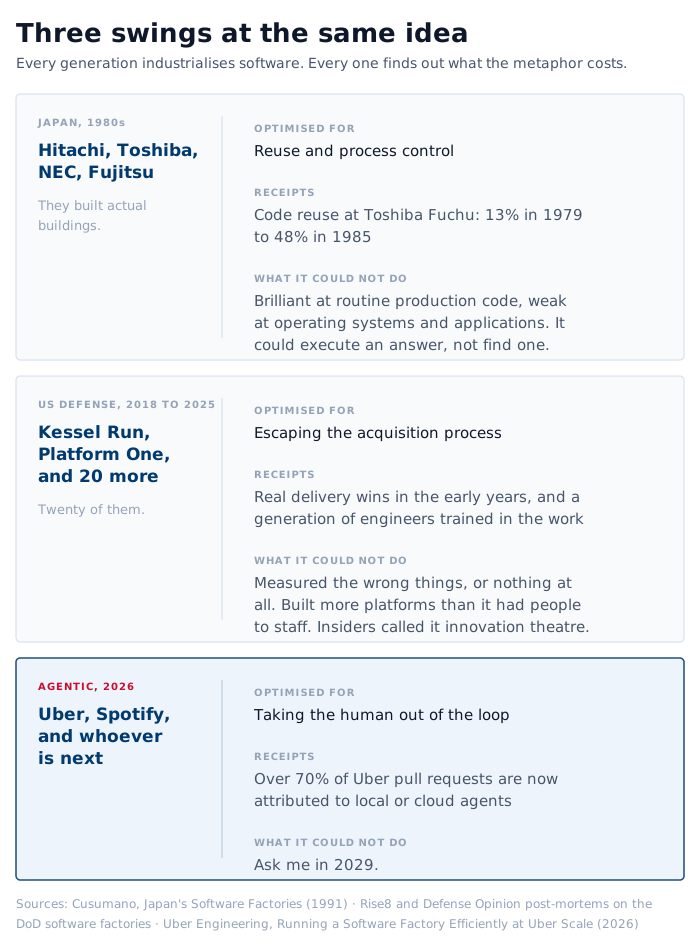
Software factories were tried in 1980s Japan and again across US Defense. Both fell short in the same way. The agentic version in 2026 is different in one specific respect, and it is not the agents.
Read
Most engineering orgs added AI but kept the rituals built for a slower era. Here are eleven things to retire this quarter, and what to replace them with.
ReadMost teams added AI to sprint workflows that no longer fit. Here's the new cadence AI-native teams run on: rituals, rhythm, and the metrics that anchor it.
Read