Hiring Engineers Won't Fix Your Delivery Problem
Slow delivery is a systems problem, not a staffing one. Adding engineers to a broken system makes it louder, not faster. Here's what actually fixes it.
When software delivery is slow, the instinct is to hire. It feels decisive. It signals investment. And it is almost never the right answer.
In most of the teams I've worked with, the bottleneck was never headcount. It was the system. The codebase was undocumented. Ownership was diffuse. The test suite didn't catch regressions. Reviews were slow because the seniors who needed to approve things were already at capacity. Adding engineers to that system does not fix those problems. It adds more load to the same bottlenecks and makes everything move slower, with a larger payroll.
In an AI-native world, this gap is widening further. Engineering team productivity is no longer primarily a function of how many engineers you have. It is a function of what your engineering system enables each engineer to do. A small team with the right infrastructure, solid tests, clear ownership, good context documentation, and AI tooling embedded in the workflow, outships a large team without it. I've watched this play out. The arithmetic has changed.
More Engineers Entering a Constrained System Just Creates More Congestion
Systems thinking is not complicated when you apply it to engineering teams. Every system has a throughput limit, and that limit is determined by the bottleneck, not the average. Adding capacity ahead of the bottleneck does not increase throughput. It creates a queue at the bottleneck and makes the problem more visible without solving it.
The classic case: a team where code review is the constraint. Two or three senior engineers are responsible for reviewing every substantive PR before it ships. They are already reviewing more than they can manage thoughtfully. You hire three more engineers. Those engineers produce PRs. The PRs join the queue. The seniors are now reviewing even more, context-switching more, spending less time on any individual review. Average review time goes up. PR quality decreases because the reviewers are spread thin. Incidents follow.
The team is bigger. Delivery is slower. The engineering team productivity number, output per engineer, has dropped. This is not a hypothetical. It is what I've seen happen when teams hire into a constrained system without fixing the constraint first. The new engineers are not the problem. The system is the problem. They just made the problem more expensive.
The right question before any engineering hire is not "how many do we need" but "where is the throughput bottleneck and can headcount actually fix it". In my experience, the honest answer to that question changes the hiring decision more often than leaders expect.
The Three Real Bottlenecks That Headcount Cannot Fix
Slow delivery typically comes from one of three places. None of them respond to more engineers.
Context debt. If a new engineer cannot become independently productive within their first week because the codebase is undocumented, the module boundaries are unclear, and the architecture decisions are buried in Slack threads from two years ago, you do not have a headcount problem. You have a context infrastructure problem. Every engineer you hire into that system requires weeks of senior time to onboard. The seniors who are already at capacity now have a new cost: bringing the new hire up to speed. You have added a negative productivity event before getting any benefit.
Context debt compounds. The more engineers working in an undocumented system, the more decisions get made without the context to make them well. Code is added that conflicts with decisions nobody knew existed. Modules drift further from their original intent. The next hire inherits an even harder onboarding problem. The fix is not more engineers. It is documentation, architecture decision records, and the discipline to maintain them. That is a week of focused work from your existing team, not a hiring cycle.
Ownership gaps. If nobody clearly owns the modules in your core codebase, two things happen. Code review depth drops because reviewers lack the context to assess changes properly. Rework increases because changes conflict with decisions only the original author understood. These two effects compound: more rework creates more PRs, which creates more review load, which means less context per review, which means more rework.
No amount of hiring fixes diffuse accountability. If you add engineers to a system where ownership is unclear, you add more contributors to the modules where ownership is already weakest. The unclear areas get more code, less coherent ownership, and more risk. The fix is assigning ownership explicitly and making the owners responsible for review quality in their modules. That is a structural decision. It takes a conversation, not a headcount request.
Test discipline. If your test suite does not reliably catch regressions, shipping more code ships more risk. Every engineer you hire accelerates the rate at which untested assumptions go to production. Your incident rate scales with your team size, not because more engineers create more incidents by being careless, but because you are systematically shipping more surface area with the same undercoverage.
Hiring does not change the test culture. If your team has a pattern of shipping without adequate test coverage, that pattern will continue with more people. The fix is a leadership decision about what done means. If a PR without meaningful test coverage can merge, you have defined done incorrectly. That definition change costs nothing but a conversation and enforcement. It does not require a hire.
In an AI-Native Team, the Multiplier Is in the System, Not the Headcount
The economics of engineering team productivity have shifted in the last two years. Before AI tooling, the relationship between headcount and output was roughly linear. More engineers meant more code shipped, bounded by coordination costs and onboarding overhead. The curve was positive but bending.
With AI tooling embedded in a well-structured engineering system, the relationship changes. According to McKinsey's research on developer productivity, AI-assisted developers complete tasks 35-40% faster on average. But that average hides a much wider distribution. The uplift for engineers working in a well-structured system with clear context, fast tests, and clean CI is substantially higher. The uplift for engineers working in a messy system with no documentation and a flaky test suite is close to zero or negative, because the AI generates confident-sounding code that is wrong in ways the test suite cannot catch.
The teams I've seen get the best results from AI are not bigger teams. They are architecturally different teams. They invested in the system: context files so the AI understands the codebase, test suites that run fast and give clear signal, CI that produces structured output, ownership that is explicit. With that infrastructure in place, one engineer with AI tooling handles what three engineers handled before. The arithmetic is real, and I have watched it in practice.
That means the headcount math changes. If your current team of ten is underperforming because of system constraints, hiring five more engineers is an expensive way to move slowly. Fixing the system constraints for the ten you have is a faster, cheaper path to the output you need. After fixing the system, you may find you need two more engineers instead of five. Or none.
The Hire That Actually Changes the Equation Is Someone Who Fixes the System
There is one hire that does meaningfully change delivery speed in a constrained system. It is not a senior engineer. It is someone whose job is to fix the system itself.
This is the argument for a fractional CTO, a staff engineer with a platform mandate, or an engineering transformation lead. The constraint is not code production. The constraint is the system that code production runs on. Hiring someone to produce more code does not address the constraint. Hiring someone to fix the constraint does.
What does fixing the system look like in practice? It looks like documenting the architecture so engineers can navigate it independently. It looks like assigning explicit ownership to every module and making owners responsible for review depth. It looks like establishing a definition of done that includes test coverage. It looks like restructuring CI output so failures are diagnosable. These are not glamorous projects. They do not produce features. They make every feature produced afterward faster, cheaper, and less risky to ship.
The ROI on that work is high. Research on the cost of a bad engineering hire and poor team structure consistently shows that the cost of misdiagnosed delivery problems runs into hundreds of thousands of dollars annually when you factor in wasted headcount, incident costs, and the opportunity cost of senior engineers firefighting instead of building. Fixing the system costs a fraction of that, and the benefit compounds.
The question I ask engineering leaders who come to me with a delivery problem is simple: what would it take to make your current team twice as effective? That question usually reveals the system constraints immediately. The answer is almost never "hire more engineers". It is almost always some combination of context infrastructure, ownership clarity, test discipline, and measurement.
Once those constraints are addressed, the team's effective capacity often increases significantly before adding a single new person. Then, if growth still requires more engineers, you are adding them to a system that can absorb them productively. Onboarding is faster. Reviews are stronger. The new hire is effective in days rather than weeks.
Slow Delivery Is a Diagnostic Problem Before It Is a Resource Problem
The real issue with the reflex to hire is that it skips the diagnosis. Delivery is slow. The obvious response is more engineers. But "delivery is slow" is a symptom, not a diagnosis. The symptom could be caused by bottlenecked reviews, context debt, unclear ownership, missing test coverage, or all four at once. Each cause has a different fix. None of the fixes require headcount as a first step.
The diagnostic conversation is uncomfortable because it requires leaders to acknowledge that the problem is in their system, not in their staffing level. Hiring feels like action. Auditing your own engineering system feels like admission. But the leaders who skip the audit and go straight to headcount end up solving a systems problem with a staffing answer, and the delivery problem persists at higher cost.
Engineering team productivity is measurable if you measure the right things. Deployment frequency tells you how often you're shipping. Change failure rate tells you whether what you're shipping works. Mean time to recovery tells you how badly failures hurt. PR review time tells you where the review bottleneck is. Onboarding time to first independent PR tells you how bad your context debt is.
Most teams I've worked with track deployment frequency and cycle time. Very few track change failure rate or onboarding time. That measurement gap is why the hiring reflex is so persistent. If you cannot see where the system is breaking, you default to adding resources and hoping it helps. It usually does not. The symptom persists. The budget grows. The frustration compounds.
Setting up measurement costs almost nothing. Most of these signals are available in the tools you already have: GitHub, your incident tracker, your deployment pipeline. The data exists. The decision to look at it is a leadership choice, not a technical one.
The teams that fixed their delivery problems without hiring first did two things. They measured the right things, and they fixed what the measurements revealed. The results were consistent: delivery improved, incidents dropped, and the question of whether to hire became clearer because they could see what they actually needed.
If your delivery is slow, start with the system audit before you start the hiring process. Identify the bottleneck. Measure what matters. Fix the constraint. Then decide whether headcount is actually the variable that moves the outcome.
In most cases, it is not. The system is.
I help engineering teams close the gap between "we use AI tools" and "AI actually changed how we deliver." Book a 20-minute call and I'll tell you where the leverage is.
Thanks for reading.
Notes on AI-native products, platforms and operating models, from twenty years of building technology that pays its way. If this one landed, let's talk.
More writing
All writing →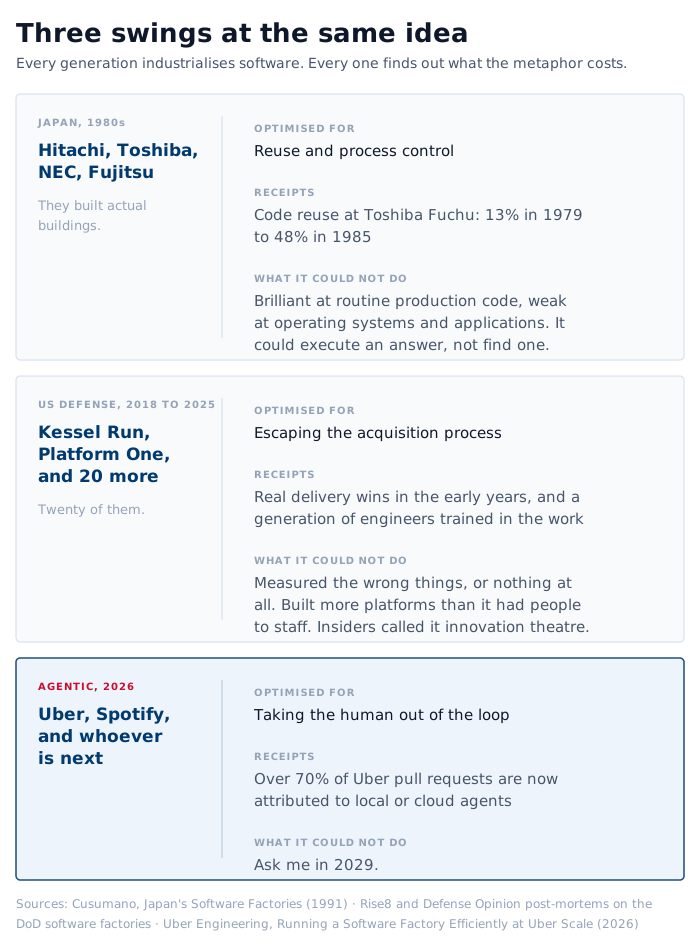
Software factories were tried in 1980s Japan and again across US Defense. Both fell short in the same way. The agentic version in 2026 is different in one specific respect, and it is not the agents.
Read
Most engineering orgs added AI but kept the rituals built for a slower era. Here are eleven things to retire this quarter, and what to replace them with.
ReadMost teams added AI to sprint workflows that no longer fit. Here's the new cadence AI-native teams run on: rituals, rhythm, and the metrics that anchor it.
Read