Vibe Coding Is Over. Here Is What Comes Next.
Vibe coding was a useful first phase. Generate, accept, ship, repeat. It worked until it didn't. The teams that figured out what comes next are operating in a different gear entirely.
Vibe coding had a good run. The term, coined by Andrej Karpathy in early 2025, described something real: a mode of working where you describe what you want, accept what the model produces, and mostly do not read it. You are vibing with the AI. It feels fast. Sometimes it is.
By mid-2025, the CTOs I spoke with were telling a different story. In an informal survey of eighteen engineering leaders, sixteen reported production incidents they traced directly to AI-generated code that nobody had read carefully. Veracode's research found that 45% of AI-generated code contains security vulnerabilities. The DORA 2025 report introduced a fifth metric, rework rate, specifically because AI-generated code was driving a measurable increase in unplanned production fixes.
Vibe coding is not a sustainable engineering practice. That does not mean AI coding tools are a mistake. It means the first phase of adoption is ending, and the second phase looks significantly different from the first.
What Vibe Coding Actually Was
To understand what replaces it, it helps to be clear about what vibe coding was.
Vibe coding was a generation-first, review-optional workflow. The model generates. You accept. The goal is to keep the generation loop moving. Reading every line of generated code was treated as friction. The value proposition was speed, and speed required not slowing down for review.
This worked well in specific contexts: throwaway prototypes, personal projects, scripts that run once, UI mockups that will be redesigned before anyone ships them. In those contexts, the cost of a bug is low, the blast radius is small, and moving fast is genuinely the right priority.
The problem was the transfer of that workflow to production contexts. The same generate-and-accept loop that works for a weekend prototype does not work for a payment processing service, a user authentication system, or a data pipeline feeding production analytics. The cost of a bug in those contexts is high. The blast radius is large. Speed matters, but it is not the only thing that matters.
Most teams never explicitly made the decision to apply vibe coding to production contexts. It happened gradually. The workflow that worked for prototypes became the default workflow. The default workflow spread to production code because nobody told it to stop at the boundary.
The Hangover: What the Data Actually Shows
The productivity gains from vibe coding are real. They are also incomplete.
Teams using AI coding tools produce significantly more pull requests per engineer. Code moves faster from idea to commit. Individual velocity metrics look better than they have in years. These gains show up in sprint reports and board decks and leadership all-hands. They are easy to see and easy to celebrate.
What is harder to see: change failure rates are up. Incident frequency has climbed across teams that adopted AI tools without changing their review and testing practices. The METR research from mid-2025 found that experienced developers actually took 19% longer to complete tasks with AI tools than without them, and believed they were 20% faster. The perception gap is not a rounding error. It is a signal that something systematic is wrong with how we are measuring.
Faros AI's analysis across real engineering organisations found no significant correlation between AI tool adoption and improvement in company-level outcomes. Individual metrics improved. System-level metrics did not. The productivity gain was real. It was also, in many cases, a liability transfer: faster code entering a system that was not designed to handle faster code, and paying for it three months later in incidents, rework, and engineer burnout.
That is the vibe coding hangover. The bill comes due slowly, which makes it easy to blame other things.
What Agentic Engineering Actually Means
The term gaining traction in practitioner communities is agentic engineering. It is not primarily about autonomous agents running long workflows, though that is part of it. It is a set of principles that describe how to use AI tools effectively in a production context.
The core distinction from vibe coding is supervision. Not line-by-line review of every character the model produces. Structured supervision: understanding what the model is doing, at what level of abstraction, with what verification steps at the boundaries.
Generate with intent, not hope. Vibe coding generates broadly and accepts what fits. Agentic engineering starts with a specific, bounded task. The more precisely you define the problem, the more likely the output is to be correct at the level that matters. A prompt that says "add authentication to this service" produces different output than a prompt that says "add JWT verification to the request handler in services/auth/handler.ts, following the pattern in services/payments/handler.ts, with tests matching the pattern in tests/services/payments/handler.test.ts." The second version is more work to write. It produces output that requires substantially less work to verify.
Verify at boundaries, not lines. The mistake many teams made in moving away from vibe coding was swinging to the opposite extreme: reviewing every line of generated code as if it were written by a contractor they do not trust. That is too slow and mostly wrong. The right level of verification is at system boundaries: does the output behave correctly when called from outside? Does it handle the error cases? Does it integrate correctly with the adjacent systems? Line-level review of the internals is often less valuable than boundary-level testing of the behaviour.
Commit frequently, in small units. One of the clearest patterns separating teams with good AI adoption outcomes from teams with bad ones is commit discipline. Teams that generate large blocks of code and commit them as a unit accumulate risk they cannot inspect or reverse. Teams that commit small, working increments have a clear audit trail, can identify exactly where something went wrong, and can roll back to a known-good state in seconds. This discipline costs almost nothing in a good workflow and pays back substantially when something unexpected happens.
Use agents for well-defined tasks, not open-ended ones. The failure mode of autonomous agents is almost always scoping: the agent interprets the task more broadly than intended and takes actions that were not authorised. The teams that are successfully running agents in production are not running them on vague briefs. They are running them on tightly specified tasks with clear success criteria, often with Hooks in place that block any operation outside the defined scope.
The Shift That Changes Everything: Prompt as Input, Not Output
The deepest shift in agentic engineering, and the one most at odds with vibe coding, is how you think about prompts.
In vibe coding, the prompt is disposable. You type something, the model generates, you accept or regenerate. The prompt is a transient input. Nobody saves it or versions it or reviews it.
In agentic engineering, the prompt is a primary artifact. The prompt that tells Claude how to run your code review process is part of your engineering system. It gets reviewed. It gets updated when the process changes. It lives in version control. It is the specification that determines the behaviour of an automated process, and specifications have the same quality requirements as the code they govern.
This reframe changes how teams think about Skills, about CLAUDE.md, about every instruction they give to AI tools. These are not throwaway prompts. They are maintained specifications. The quality of the output is directly proportional to the quality of the specification, which means the specification deserves the same engineering rigour as everything else.
Teams that have made this shift describe it as the difference between using an AI tool and building an AI-native engineering system. The tool is the same. The infrastructure around it is completely different.
What to Do If You Are Still in Vibe Coding Mode
If your team is still operating primarily in vibe coding mode, the transition does not require stopping everything and rebuilding from scratch. It requires adding structure in three places.
Add context infrastructure first. A CLAUDE.md in your repository that describes your architecture, conventions, and constraints is the fastest single improvement you can make. It does not change how developers work. It changes what context the AI has when it generates, which changes what the output looks like, which changes how much work the review requires. Teams consistently report that the volume of architectural corrections drops significantly after a well-maintained CLAUDE.md is in place.
Add one Skill for your most common task type. Identify the task type your team uses AI for most heavily: code review, test writing, API development, whatever it is. Build one Skill that encodes how your team does that task. Use it for a sprint. Update it where it misses. After four weeks you will have a Skill that reflects your actual conventions, and every developer on the team will benefit from it.
Change the commit discipline. This is behavioural rather than technical. Ask developers to commit in smaller units, at working states. No batch commits of AI-generated code. Each commit should represent a unit of work that can be reviewed, understood, and rolled back independently. This single practice change reduces the risk surface of AI adoption more than almost anything else.
None of these steps require buying a new tool, restructuring the team, or running a transformation programme. They are engineering discipline applied to a new category of tool. The teams that have made these changes consistently report better outcomes than they had in the vibe coding phase, not despite slowing down but because of it.
The era of getting away with generate-and-accept is ending. What replaces it is more systematic, more reliable, and ultimately faster, because the quality of the output is high enough that you can actually trust it.
I help engineering teams close the gap between "we use AI tools" and "AI actually changed how we deliver." Book a 20-minute call and I'll tell you where the leverage is.
Thanks for reading.
Notes on AI-native products, platforms and operating models, from twenty years of building technology that pays its way. If this one landed, let's talk.
More writing
All writing →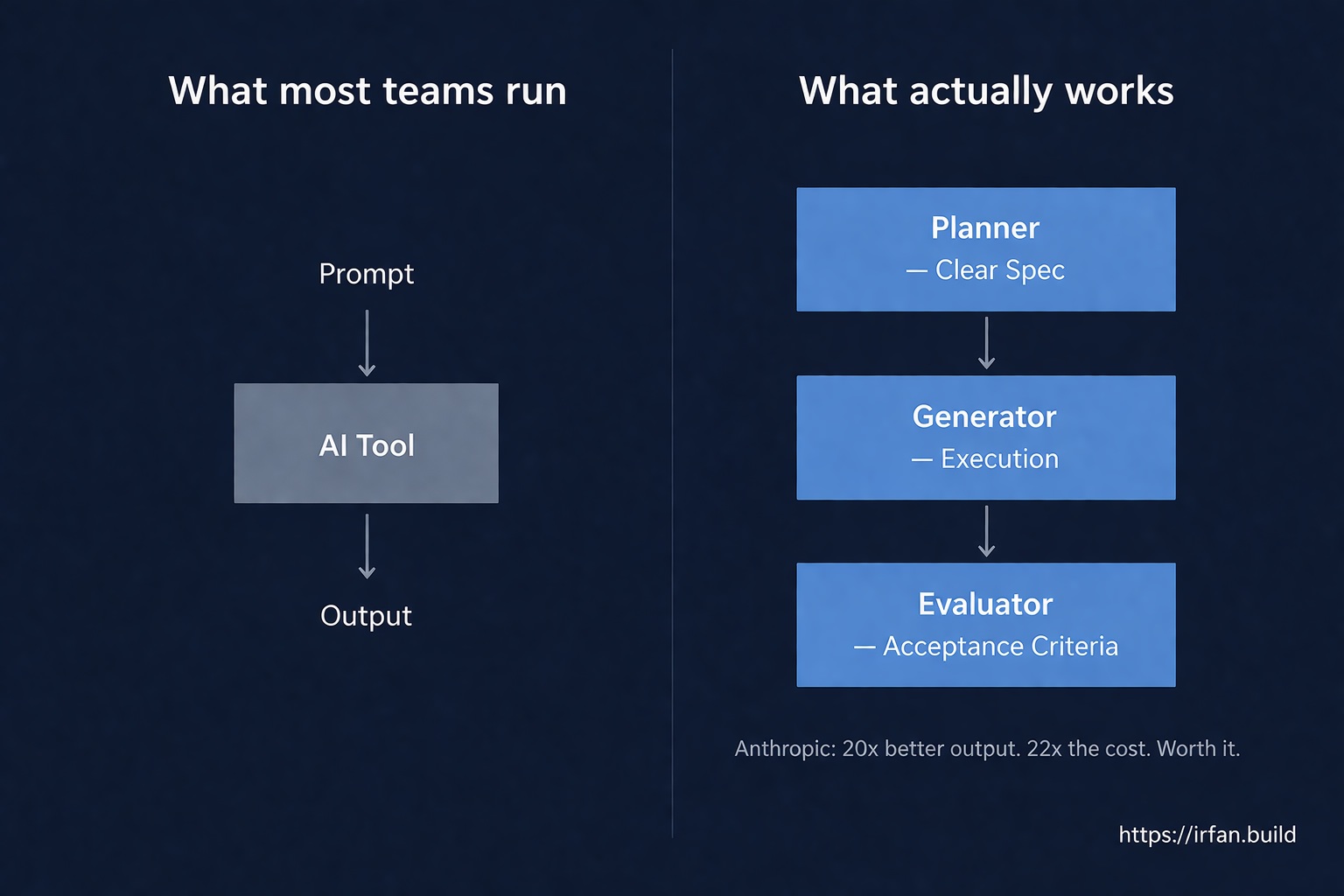
Anthropic's engineering team published a technical deep-dive on multi-agent harness design. What they actually published was an org chart, and it explains exactly why most AI initiatives produce underwhelming results.
ReadPrompt engineering is about what you say. Context engineering is about what you build. It is the emerging discipline that determines whether AI tools produce consistent, accurate output or confident-sounding nonsense.
ReadAgentic coding is not vibe coding with a longer leash. It is a specific way of structuring development work so that AI agents can execute reliably within defined boundaries. Here is what it actually looks like.
Read