Software Agency AI Disruption Is Already Here
Software agency AI disruption is reshaping who wins development work. A solo builder with the right stack out-ships agency teams on most standard projects.
The structural advantage of the software agency model was scale of execution. That advantage is gone. A capable solo builder with an AI-native workflow can now out-ship a 10-person agency on most standard software projects, at a fraction of the cost and in a fraction of the time. Agencies that survive the next three years won't do it by cutting rates or hiring faster. They'll do it by selling something AI can't commoditise: judgment, domain knowledge, and transformation capability.
This is not a prediction about where things are heading. Software agency AI disruption is already reshaping how founders buy development services and what they are willing to pay for. The middle of the market, standard CRUD applications, landing pages, basic platforms, is being eroded in real time. The agencies that haven't noticed yet are about to.
The Agency Model Was Built on a Cost Arbitrage That No Longer Exists
The traditional agency value proposition rested on three pillars. First, pooled talent was cheaper than hiring full-time engineers in a tight market. Second, agencies could ramp faster than building an in-house team from scratch. Third, they could sustain output that a lean startup couldn't support on its own. For two decades, those three things were enough to justify the premium.
AI has neutralised all three for a significant portion of projects. A skilled solo builder today doesn't need a team to sustain output. They need a well-structured codebase, a context file that tells the AI agent what the system is and how it works, and the judgment to review and direct what the agent produces. Ramp time is measured in days, not months. Output that previously required a team of four or five is now achievable by one person who knows how to use the tools.
This doesn't mean agencies are irrelevant across the board. It means the specific competitive advantage they held for well-defined, execution-heavy work has collapsed. The work that remains defensible is a smaller slice than most agency principals are willing to admit.
The math is not subtle. GitHub's 2024 developer survey found that 92% of developers were using AI coding tools in some capacity, and the productivity gains for repetitive, well-scoped work were substantial. When a solo builder can operate at that productivity level, the agency's headcount becomes overhead rather than leverage.
Solo Builders Are Shipping Products in Days That Used to Take Agency Teams Weeks
The picture of what this looks like in practice in 2026 is concrete. A solo builder working with an AI agent on a well-scoped project starts by writing the context: architecture decisions, component patterns, data model, naming conventions. That context file is what makes the agent useful across an entire codebase rather than just for individual functions. Then the agent handles the execution: components, API routes, data transformations, boilerplate. The builder reviews, directs, and makes the architectural calls. Integration and edge cases still require human judgment. The routine work does not.
I've seen this pattern produce production-ready MVPs in three to five days on projects that would have taken an agency team three to six weeks. The difference is not the quality of the individual engineers in either scenario. It's the ratio of judgment to execution. AI has shifted that ratio decisively in favour of the solo operator who knows how to run the tools.
The indie hacker and solo founder community has been demonstrating this for the past eighteen months. Projects that previously required co-founders or early hires to get off the ground are now being launched by individuals. The constraint has moved from "do I have enough engineering capacity?" to "do I have a clear enough specification to give the AI agent useful context?"
That shift has direct implications for agencies. If a solo builder can ramp in days and sustain output that a team used to require, the agency's delivery timeline and cost structure are no longer competitive on the majority of project types. The agency needs to be selling something the solo builder cannot deliver. Execution is no longer that thing.
Software Agency AI Disruption Is Thinning the Pipeline for Commodity Work
Buyers of development services are smart. When a founder sees a solo builder ship a working MVP in two weeks for a cost that fits within a pre-seed budget, and compares that to an agency proposal for three months of work at a significantly higher rate, they make the obvious choice. This is happening across the market right now, and the agencies feeling it most are the ones that built their business on execution volume at a predictable hourly rate.
The category of work at risk is large: standard web applications, internal tools, data dashboards, e-commerce platforms, marketing sites with CMS integrations, basic SaaS products with well-understood patterns. This is a significant portion of what most agencies deliver. It is also the work that AI handles best, because the patterns are well-established and the AI has seen them thousands of times.
What's left after you remove commodity execution from the agency menu is a shorter list. Complex system integrations where the interfaces are messy and undocumented. Regulatory environments where the domain knowledge is non-obvious and the cost of getting it wrong is high. Architectural decisions where the choice of approach has long-term consequences that aren't visible in a well-scoped brief. Team transformation and coaching. Audit and due diligence on technical decisions.
The agencies that haven't yet felt the pressure from software agency AI disruption tend to be in one of two places: they have strong existing client relationships that insulate them from the open market, or they're operating in a domain where the work is genuinely complex and judgment-intensive. Both of those positions are more durable than competing on execution volume, but neither is a permanent shield.
The transition the market is making is from buying hours to buying outcomes. And on execution-heavy outcomes, the solo builder with AI tools is now a credible alternative at a fraction of the price.
The Agencies That Will Survive Are Selling Judgment, Not Hours
The work that resists commoditisation is not execution. It is the reasoning that decides what to execute and how. An AI agent can write the code to rebuild a payment architecture. It cannot tell you whether rebuilding it is the right decision given your team's current capability, your regulatory obligations, your customer expectations, and your twelve-month runway. That reasoning is where experienced judgment creates value that cannot be replicated by the tools alone.
Agencies that will be relevant in three years are building their positioning around this explicitly. They're not competing on delivery speed or headcount. They're competing on the quality of the decisions they make upstream of delivery. Strategic architecture. Technical due diligence. Integration design in complex legacy environments. Regulatory navigation in industries where compliance is non-obvious. Team transformation programmes that change how an engineering organisation works, not just what it ships.
This is a meaningful shift in what agencies need to hire and develop. A team of strong execution engineers who are now augmented by AI is a cheaper version of what the agency used to sell. A team of strong decision-makers and domain experts who use AI to execute their recommendations faster is something genuinely different.
The transition is not automatic, and it is not comfortable. It requires agencies to charge for thinking in a market that was trained to pay for hours. It requires building domain expertise that is specific enough to be valuable, rather than generalist enough to take any brief. And it requires leadership that can articulate clearly what problem the agency is actually solving, not what category of work it delivers.
The agencies that are making this transition are doing it by narrowing. They are choosing a domain and going deep. Fintech compliance. Healthcare data. Marketplace architecture. AI-native transformation. The breadth that used to be a selling point, "we can build anything", is becoming a liability when "anything" can now be built by a single skilled person with the right tools.
If You're Buying Development Services in 2026, the Old Heuristics No Longer Apply
If you are buying development work right now, the landscape has changed enough that the old heuristics are not reliable guides.
For well-defined, well-scoped work, the case for a traditional agency is weak. If you can describe what you need with enough precision that you could write a good specification, an AI-native solo builder with a track record on similar projects is likely to deliver faster and cheaper. Ask them to walk you through their workflow. If they can't explain concretely how they use AI tools in their delivery process, they're probably not saving you what they could be.
For ambiguous, high-stakes, or architecturally complex work, the calculus is different. If the problem involves legacy system integration with undocumented interfaces, regulatory constraints that require deep domain knowledge, or architectural decisions that will shape your engineering organisation for the next three to five years, you need experienced judgment, not execution capacity. Here, paying for an agency or an independent advisor with genuine domain expertise is still the right decision.
The question to ask any vendor is simple: where in your engagement does AI feature, and what does it do? The answer tells you a great deal about what you're actually buying. An agency that has integrated AI into their delivery process is effectively selling senior judgment at a higher ratio. An agency that hasn't is selling you execution at a price that doesn't reflect the current market.
The second question is about the work they're most proud of. If the answer is a list of delivered applications, you're buying execution. If the answer is a set of technical decisions that shaped the direction of a product or an engineering team, you're buying judgment. The two are priced differently for a reason, and in 2026 only one of them is underpriced.
One practical test: ask any agency or solo builder for a case where they pushed back on the client brief. Where did they tell a client that what they asked for was not the right approach, and why? Execution providers take the brief and deliver. Judgment providers engage with the problem before they agree to the approach. That's the difference that matters now.
The Window for Agencies to Make This Transition Is Not Indefinitely Open
The agencies that have already started moving toward judgment-based positioning are building a lead that will be difficult to close. Domain expertise compounds. Reputation for strategic thinking compounds. Client relationships built on outcomes rather than deliverables compound. The agencies still competing on execution volume are running a race against tools that improve every month and solo builders who are getting faster.
Software agency AI disruption is not a future scenario. The disruption is underway. The middle of the market is thinning. Clients who used to default to an agency brief are now having real conversations about whether a solo builder with a modern stack can get them further, faster. Those conversations are not going to stop.
The agencies that survive will have answered a clear question: what do we know that the AI doesn't, and why does that knowledge produce better outcomes for our clients? If the honest answer to that question is "nothing specific", the transition is urgent. If the answer is specific, the job is to communicate it clearly and build a business model around it.
For founders buying services and for engineering leaders thinking about how they structure external relationships, the framing is the same. The value is in the judgment. The execution is increasingly a given. Price and structure your decisions accordingly.
I help engineering teams close the gap between "we use AI tools" and "AI actually changed how we deliver." Book a 20-minute call and I'll tell you where the leverage is.
Thanks for reading.
Notes on AI-native products, platforms and operating models, from twenty years of building technology that pays its way. If this one landed, let's talk.
More writing
All writing →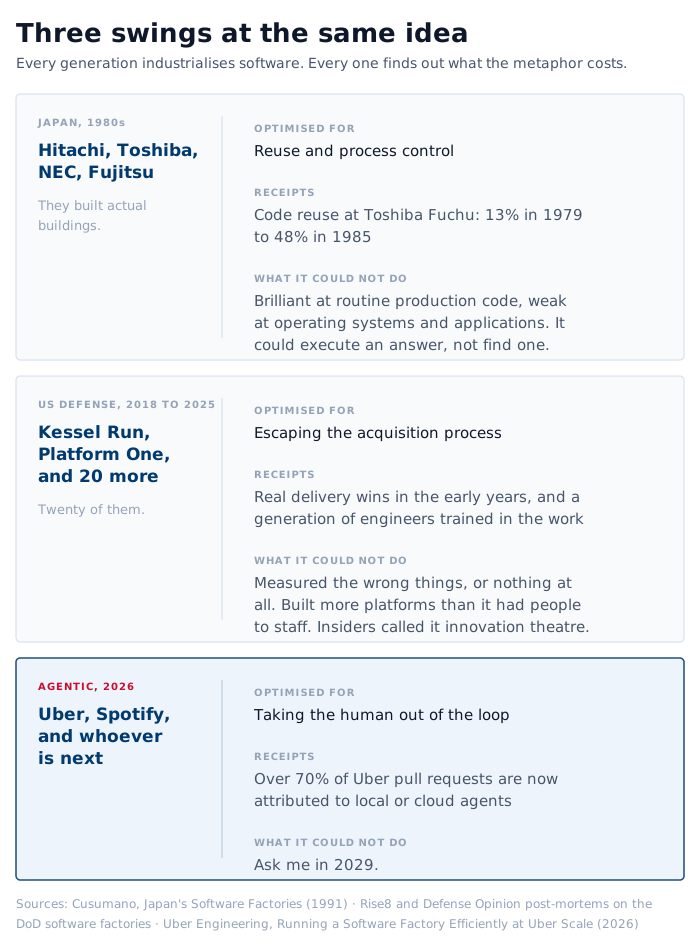
Software factories were tried in 1980s Japan and again across US Defense. Both fell short in the same way. The agentic version in 2026 is different in one specific respect, and it is not the agents.
Read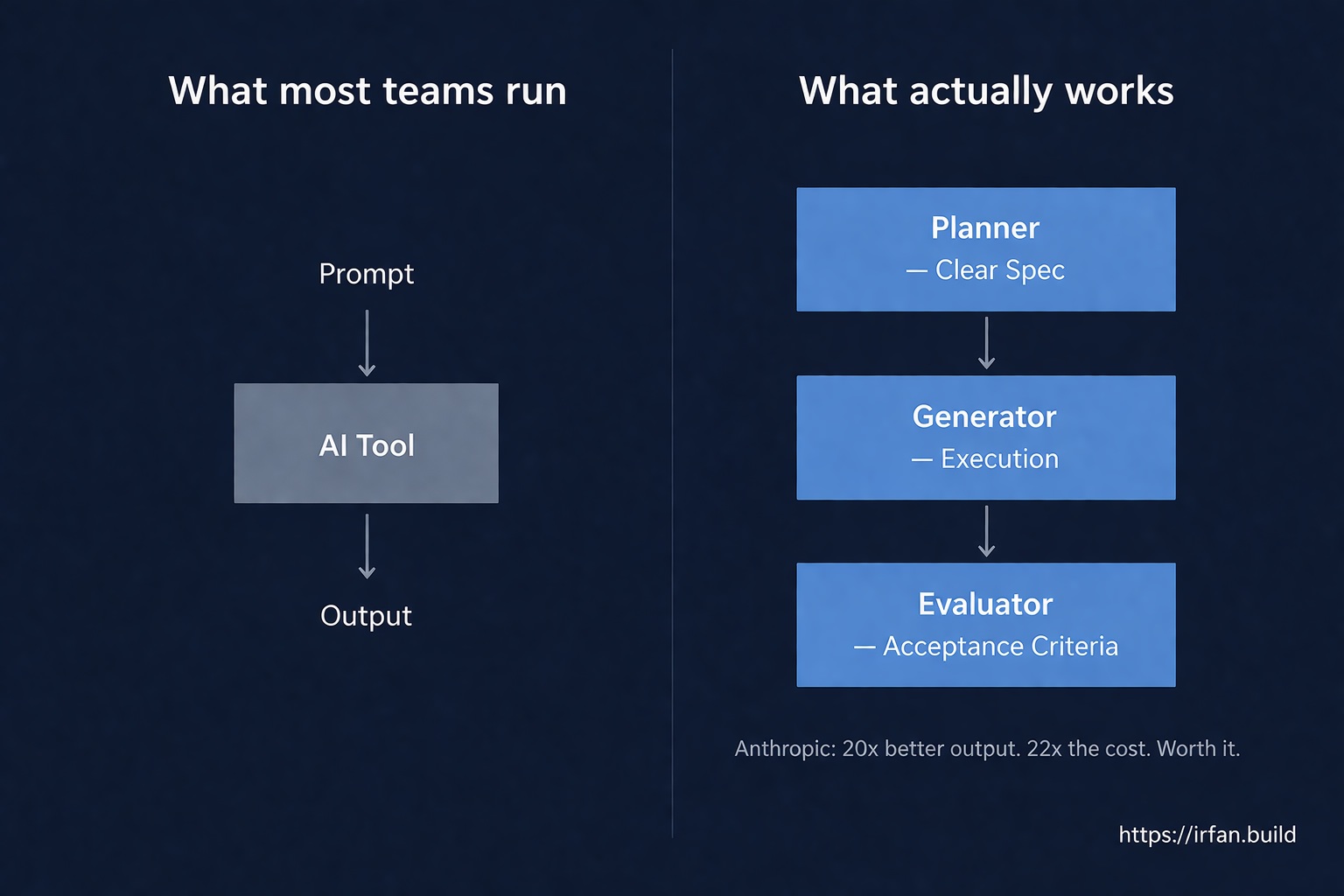
Anthropic's engineering team published a technical deep-dive on multi-agent harness design. What they actually published was an org chart, and it explains exactly why most AI initiatives produce underwhelming results.
ReadThree different tools with three different design philosophies. Here is an honest comparison from someone who has used all three in production, and the framework for deciding which one belongs in your workflow.
Read