Replacing an Offshore Engineering Team Without Killing Velocity
The cost-arbitrage era of offshoring is ending. AI changes the math. Here's how to transition from a large offshore team to a smaller, faster onshore one.
The era of cost-arbitrage offshoring is ending. Not because offshoring was always wrong, but because AI has changed the economics so fundamentally that the original business case no longer holds. A smaller onshore team with proper AI tooling now outperforms a large offshore team on raw output, quality, and iteration speed. The companies that recognize this early will restructure. The ones that don't will keep paying more for less.
This is not a theoretical argument. I've run this transition. I've watched teams go from 25 offshore developers to 8 onshore engineers with AI tooling embedded in every stage of delivery, and ship more, faster, with fewer defects. But the transition itself is where most companies fail. They either move too fast and crater velocity, or they move too slowly and pay for two teams doing the work of one. The sequence matters more than the decision.
AI Changed the Arithmetic, Not Just the Tools
The original offshore proposition was simple: engineers in lower-cost markets cost less per hour, so you get more hours for the same budget. More hours, more output. For a decade, that math worked well enough. The quality gap and communication overhead were real, but the cost savings covered them.
AI broke that equation. When a single engineer with Claude Code or Copilot can produce what previously took three or four engineers, the cost-per-unit-of-output flips. The savings from cheaper hourly rates get overwhelmed by the productivity multiplier that AI gives to engineers who can use it well.
According to McKinsey's 2024 research on developer productivity, engineers using AI coding tools are completing tasks 20-45% faster, with the gains concentrated in code generation, test writing, and documentation. That range matters. A 20% gain is nice. A 45% gain means your onshore team of 10 is doing the work your offshore team of 18 used to do, at higher quality, with faster feedback loops.
The multiplier is not evenly distributed. Engineers who work in well-structured codebases with strong documentation, clear module boundaries, and comprehensive test suites get the largest gains. Engineers working in messy, undocumented systems get far less. This is the first clue about why offshore teams specifically lose the most from the AI shift: they are almost always working in the conditions where AI helps least.
I have watched teams run the same sprint with and without AI tooling. The difference is not marginal. It is structural. The team with AI closes tickets faster, writes more comprehensive tests, and produces better documentation as a byproduct of the workflow. That gap compounds every sprint.
Offshore Teams Underperform in 2025 for Reasons That Cost Savings Cannot Fix
The problems with offshore engineering in 2025 are not the problems companies think they have. It is not about talent. There are excellent engineers everywhere. The problems are structural, and they compound.
Context debt across timezones. When your product team is in one timezone and your engineering team is in another, every decision has a 12-24 hour feedback loop. Questions asked in the morning get answered the next morning. Ambiguity in a requirement that an onshore engineer would resolve with a five-minute conversation becomes a full day of blocked work, or worse, a day of work built on the wrong assumption. I've seen teams where 30% of offshore output was rework caused by timezone-delayed clarification. That is not a communication problem you can solve with better standups. It is a structural latency baked into the model.
AI tooling adoption gap. Most AI coding tools work best with tight feedback loops: write code, get suggestions, iterate, test, refine. That workflow assumes the engineer has deep context on the product, the architecture, and the current sprint goals. Offshore engineers, by the nature of the model, carry less context. They are further from the product decisions, further from the users, further from the architectural intent. The AI tools amplify whatever context the engineer has. Less context in, less useful output out.
The teams I've worked with that have the highest AI adoption are the ones where engineers sit close to the product decisions. They understand why something is being built, not just what. That understanding is what lets them prompt effectively, evaluate suggestions critically, and catch when the AI generates something technically correct but architecturally wrong.
Communication overhead eating the savings. Every offshore engagement I've seen has a coordination layer: project managers, scrum masters, liaison roles whose entire job is translating between the onshore and offshore teams. These roles exist because the model requires them. Remove the offshore team, and those coordination roles disappear. The cost savings from cheaper hourly rates look different when you add back the management overhead, the rework cycles, and the velocity tax of timezone gaps.
The Transition Takes 3-6 Months, and the Sequence Is Everything
Most companies get the sequence wrong. They either try to cut over in a single sprint, which craters delivery, or they run both teams indefinitely, which doubles cost without doubling output. The right approach has four distinct phases.
Phase 1: Audit (Weeks 1-3). Map every active workstream the offshore team owns. Identify which ones are critical path, which are maintenance, and which are already stalled. Document the knowledge that exists only in the offshore team's heads: deployment procedures, undocumented APIs, environment-specific configurations, the workarounds nobody wrote down. This phase is unglamorous and essential. Skip it, and your transition will stall at knowledge transfer.
Phase 2: Parallel running (Weeks 4-10). Bring your onshore team up to capacity while the offshore team is still active. The onshore team takes ownership of new work and critical path items. The offshore team shifts to maintenance, bug fixes, and knowledge documentation. Both teams are running, which is expensive, but this overlap is where knowledge actually transfers. It does not transfer through documents alone. It transfers through the onshore team asking questions while the offshore team is still there to answer them.
Phase 3: Knowledge transfer and tooling (Weeks 8-14). Overlap with Phase 2 intentionally. This is where you instrument the onshore team with AI tooling, set up the codebase documentation that makes AI effective, and run the offshore team down to a skeleton crew handling only the items the onshore team has not yet absorbed. The AI tooling setup is not just installing extensions. It is structuring the repo so that AI tools have the context they need: clear module boundaries, architecture decision records, comprehensive test suites, and documentation that a language model can actually use.
Phase 4: Cutover (Weeks 12-24). The offshore team is fully wound down. The onshore team owns everything. You will have a period where some legacy knowledge gaps surface; things the offshore team knew but did not document. Budget for this. It is inevitable and manageable if you planned for it.
The total timeline is 3-6 months depending on the size of the codebase and the quality of existing documentation. Teams with strong documentation and clear ownership boundaries finish faster. Teams with years of undocumented offshore development take longer. This should not surprise anyone.
The Velocity Dip Is Real, Predictable, and Temporary
Here is what nobody tells the executive team: output will drop during the transition. It drops in Phase 2 when the onshore team is ramping and the offshore team is shifting to support mode. It drops again briefly in Phase 4 when knowledge gaps surface.
In the transitions I've run, the velocity dip follows a consistent pattern. Output drops 15-25% in weeks 4-8 as the onshore team absorbs context. It recovers to baseline by weeks 10-14. By week 16-20, it exceeds the pre-transition baseline, often by 30-40%, because the smaller team with AI tooling is now operating without the coordination overhead, timezone delays, and rework cycles that were invisible costs in the old model.
Managing stakeholder expectations during the dip is half the job. If leadership expects a seamless cutover with no output impact, you will lose their confidence exactly when you need it most. Set the expectation early: there will be a 6-8 week period where delivery slows. Show them the recovery curve from comparable transitions. Give them a weekly metric they can track, something simple like PRs merged per week or features shipped to staging, so they can see the recovery happening in real time.
The worst outcome is a transition that gets cancelled at week 6 because someone panicked about the velocity dip. That leaves you with a demoralized onshore team, a confused offshore team, and the same structural problems you started with, plus the cost of the transition attempt. I have seen this happen. It is expensive, demoralizing, and entirely avoidable with proper expectation setting upfront.
The End State: 8-10 Engineers Outshipping 25
What does the other side look like? In the teams I've seen complete this transition, the end state is remarkably consistent. A team of 8-10 engineers with AI tooling embedded in their workflow, working in a well-structured codebase, shipping more features per sprint than the previous team of 20-25.
The reasons are straightforward. Each engineer carries full context on their domain. There is no coordination layer between an onshore product team and an offshore delivery team. Decisions that used to take 24 hours of back-and-forth now take 15 minutes. AI tooling multiplies the output of each engineer because they have the context that makes AI suggestions useful. Test coverage is higher because AI-assisted test generation is fast when the codebase is well-structured. Code review is faster because the team is small enough that every reviewer understands the system.
The cost comparison is not even close. The loaded cost of 8-10 senior onshore engineers is often comparable to or less than the fully-burdened cost of 25 offshore engineers plus the coordination layer, the rework, and the management overhead. You are paying similar amounts for dramatically more output, higher quality, and faster iteration cycles.
This is not about onshore engineers being better. It is about the model. A small, high-context team with AI leverage is a fundamentally different operating model than a large, distributed team optimized for cost per hour. The unit economics are different. The feedback loops are different. The quality ceiling is different.
Keeping the Offshore Team Is Sometimes the Right Call
Not every offshore engagement should be unwound. There are legitimate cases where the model still works.
If your offshore team has been stable for years, carries deep domain knowledge, and operates with genuine autonomy rather than requiring constant direction from an onshore product team, the calculus is different. These teams have already solved the context problem. They are not offshore labor; they are a distributed engineering team that happens to be in another country. The distinction matters.
If your product requires 24-hour coverage, timezone distribution is a feature, not a bug. Follow-the-sun support models and globally distributed systems work better with teams in multiple timezones. Consolidating to a single timezone would create operational gaps.
If you are in a regulated industry where specific compliance requirements mandate local data handling or local engineering presence in certain markets, the decision is not purely about efficiency.
The cases where offshoring should be revisited are the common ones: teams that were built for cost savings, operate with high coordination overhead, carry less context than the onshore team, and have not adopted AI tooling at the rate the onshore team has. That describes most offshore engineering engagements I have seen. The ones built for cost arbitrage are the ones where the math has changed the most.
The question is not "is our offshore team bad?" The question is: "if we were building this team from scratch today, with today's AI tooling and today's economics, would we build it the same way?" For most companies, the honest answer is no. And if the answer is no, the only question left is how to transition without destroying what you have while you build what you need.
I help engineering teams close the gap between "we use AI tools" and "AI actually changed how we deliver." Book a 20-minute call and I'll tell you where the leverage is.
Thanks for reading.
Notes on AI-native products, platforms and operating models, from twenty years of building technology that pays its way. If this one landed, let's talk.
More writing
All writing →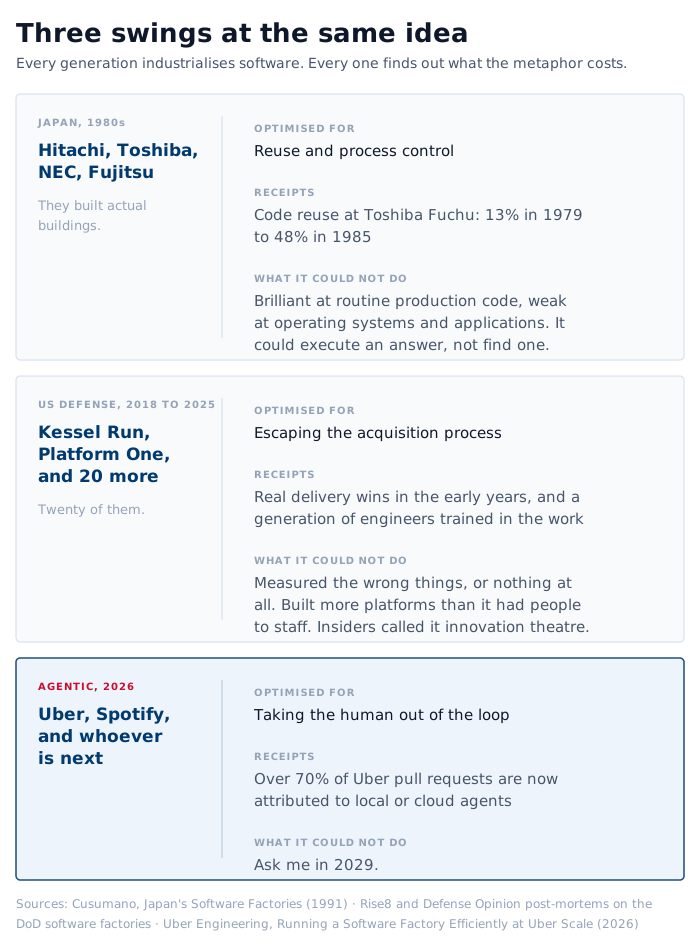
Software factories were tried in 1980s Japan and again across US Defense. Both fell short in the same way. The agentic version in 2026 is different in one specific respect, and it is not the agents.
Read
Most engineering orgs added AI but kept the rituals built for a slower era. Here are eleven things to retire this quarter, and what to replace them with.
ReadMost teams added AI to sprint workflows that no longer fit. Here's the new cadence AI-native teams run on: rituals, rhythm, and the metrics that anchor it.
Read