The Org Chart Didn't Change. The Work Did.
Engineering teams adopted AI into org structures built for slow execution. Coding is no longer the bottleneck. The structure is. Here is where to start.
Engineering teams adopted AI tools into org structures designed for human-paced execution. The sprint cadence, the QA process, the review workflow, the EM's job description: all of it was built for a world where writing code was the constraint. Coding is no longer the constraint. The structure is. And unlike a tool, structure does not change by clicking a setting.
The gap between what AI can do and how most engineering organisations are set up to operate is now the primary drag on AI value. Not tool quality. Not adoption rate. Not engineer capability. The management system itself. This is the problem most engineering leaders are not yet naming directly.
The teams pulling ahead are not the ones with the best AI tools. They are the ones that recognised coding became cheap and restructured around the bottlenecks that replaced it.
The Engineering Org Was Designed Around a Bottleneck That No Longer Exists
Every major artefact of the traditional engineering org, sprints, standups, story points, ticket queues, was invented to manage scarcity of execution capacity. Building things was slow. The whole system grew up to manage that slowness.
Sprint planning exists to prioritise what gets built when you cannot build everything at once. Standups exist to surface blockers in a world where a blocked engineer is a significant cost. Story point estimation exists to give leadership visibility into a resource-constrained production system. These are not bad ideas. They are correct ideas for a specific problem: coding is expensive, so manage it carefully.
AI changes the premise. A single engineer using Claude Code can now produce code in hours that would have taken days. The production constraint is gone, or close to it. But the management system built around that constraint is still running, unchanged, on top of a fundamentally different reality.
The tell is in how teams respond to this. Most leaders, when they see AI-generated PRs piling up in review, ask engineers to review faster. They add reviewers. They schedule review blocks. They treat it as a throughput problem inside the existing structure. What they are actually looking at is the structure signalling that it was not built for this volume. Asking people to move faster inside a broken structure does not fix the structure.
The result is an engineering org that is genuinely faster at writing code and still slow everywhere else, because everything else was designed to manage the pace of code production, not to operate independently of it.
What AI Actually Changed About How Work Flows
When coding was the bottleneck, everything downstream of it was sized to match. QA had capacity to review a certain number of PRs per sprint. Deployment processes assumed a certain frequency of changes. Code review was designed for a volume that roughly matched what engineers could produce in a two-week cycle.
AI broke all of those ratios at once. Cortex.io's 2026 benchmark data shows PR volume up 98% on high-adoption teams. Review time per PR is up 91%. Bottom-quartile teams are sitting at 35-plus hours to merge a PR. The production side of engineering doubled. The downstream systems absorbed that doubling without expanding.
What changed is where the work is waiting. Before AI, work waited to be built. Now work waits to be reviewed, verified, and deployed. The queue moved. But the org is still structured as if the queue is in building.
The 35-plus hours to merge a PR in bottom-quartile teams is not a people problem. Those engineers are not lazy or slow. They are operating inside a review and deployment process that was calibrated for a different input volume. The process has not been recalibrated. That is a structural decision, or more precisely, an absence of one.
This is not an execution problem. It is a structural problem. You cannot solve a structural mismatch by asking people to work faster. You solve it by changing the structure.
Where the Mismatch Shows Up, and Why It Is Invisible Until It Hurts
The structural mismatch does not announce itself cleanly. It shows up in friction that gets attributed to other causes.
Sprint planning sessions that used to take two hours now take two hours to plan half the work, because teams are producing more than they can confidently commit to. The instinct is to improve estimation. The actual issue is that estimation was designed to manage production scarcity, and production scarcity is no longer the problem.
QA backlogs that were manageable before AI adoption are now consistently overloaded. Teams add QA headcount or ask engineers to do more testing. The actual issue is that QA was sized for a PR volume that no longer matches what the team produces. More headcount does not fix a process that was not designed for this volume.
Engineering Managers are measured on velocity: story points closed, sprint completion rate, PR throughput. In a world where coding was the constraint, velocity was a reasonable proxy for team health. In a world where coding is cheap, velocity is often the wrong question. The right question is: how good is the judgment going into what we build and how we review it? But there is no metric for that in most organisations, so the EM optimises for what is measured.
The pattern I've seen most clearly: a team runs a successful AI pilot, velocity goes up, leadership is happy, they scale the tool rollout, and three months later the team is slower than before and nobody can explain why. What happened is not that AI stopped working. What happened is that the structural problems the pilot was too small to surface became the dominant constraint at scale. The QA backlog that was marginally OK at ten PRs a week is a crisis at twenty-five. The review process that was fine when engineers were cautious is a bottleneck when engineers are prolific.
The 87% of companies that have AI pilots and the 8.6% that have scaled to production: the gap is mostly explained by this mismatch. Pilots work because they are small enough to sidestep structural problems. Scaling fails because the structure cannot absorb what the tools produce.
What the Right Structure Looks Like When Coding Is Cheap
The teams that have navigated this well are not necessarily restructured at the org chart level. What changed is what the structure is optimised for.
The new bottlenecks are context quality, review judgment, and deployment confidence. The org structure that serves those bottlenecks looks different from the one that served production capacity.
Fewer handoffs. Every handoff is a place where context degrades. The traditional build-then-QA-then-deploy model has handoffs by design, because handoffs were how you managed quality when production was slow. When production is fast, handoffs are where speed gets absorbed and where context is most likely to be lost. Teams moving fastest have the shortest handoff chains, with engineers owning more of the full cycle.
Stronger module ownership. When AI is generating code at volume, the difference between a module with clear ownership and one without is the difference between review that catches real problems and review that checks formatting. Ownership needs to be explicit, not assumed.
QA integrated earlier, not appended at the end. The QA process most teams run was designed to catch errors before production. In an AI-native workflow, that same goal is better served by involving QA thinking earlier: in the prompting, in the specification, in the test coverage before the PR is submitted. End-of-cycle QA at high PR volume is a structural failure mode.
EMs accountable for context quality, not throughput. The most valuable thing an EM can do in an AI-native environment is ensure that engineers are working with high-quality context: clear specifications, well-defined boundaries, documented architecture decisions. That is what determines whether AI produces good output or plausible-looking output that breaks in integration. Most EMs are not measured on this. Most organisations do not have a clear definition of what good context quality even looks like.
The separation between building and verifying also becomes more important, not less, when coding is cheap. When output volume is low, the same engineer can reasonably hold both responsibilities. When output volume doubles, the verification function gets absorbed into production if it is not explicitly protected. Teams that have done this well treat verification as a first-class activity with dedicated time, not as something that happens at the end of the sprint if there is time left. The structure has to make space for it, because the culture alone will not.
How to Start Without a Full Reorg
The structural mismatch does not require a reorg to start fixing. It requires an honest audit of where work is actually waiting.
I have run this audit across teams in different contexts, and the pattern is consistent. In most teams post-AI adoption, the wait is in review and deployment, not in building. Engineers are producing. The work is queuing at review, at QA, at deployment approval. That is where to start.
Map the queue. For the last two sprints, track where each piece of work spent the most time: in building, in review, in QA, in deployment, in waiting for clarification. If review and deployment together account for more than half the cycle time, your structure is mismatched for the volume you are now producing.
Pick one handoff to compress. You do not need to eliminate all handoffs at once. Pick the one where context is most consistently lost or where wait time is longest. Most teams, when they do this honestly, identify the same handoff: the one between code completion and QA. Start there.
Redefine what EMs are accountable for. This does not require a new performance framework. It requires a direct conversation: what does good context quality look like for this team, and how will we know if we have it? The answers to those questions are more useful than any sprint velocity target.
Audit ownership. For every module in your core systems: who owns it, and do they have the context to review AI-generated contributions to it? If ownership is unclear on more than a handful of modules, that is where your review quality is lowest and your risk is highest.
None of this is a reorg. It is an acknowledgement that the work changed and the structure needs to catch up. The teams that are compounding advantage on AI adoption are the ones that made that acknowledgement six to twelve months ago and built from there.
The teams still optimising for sprint velocity and story point throughput are running faster inside a system designed for a constraint that no longer exists. The speed is real. The structure is the limit.
I help engineering teams close the gap between "we use AI tools" and "AI actually changed how we deliver." Book a 20-minute call and I'll tell you where the leverage is.
Thanks for reading.
Notes on AI-native products, platforms and operating models, from twenty years of building technology that pays its way. If this one landed, let's talk.
More writing
All writing →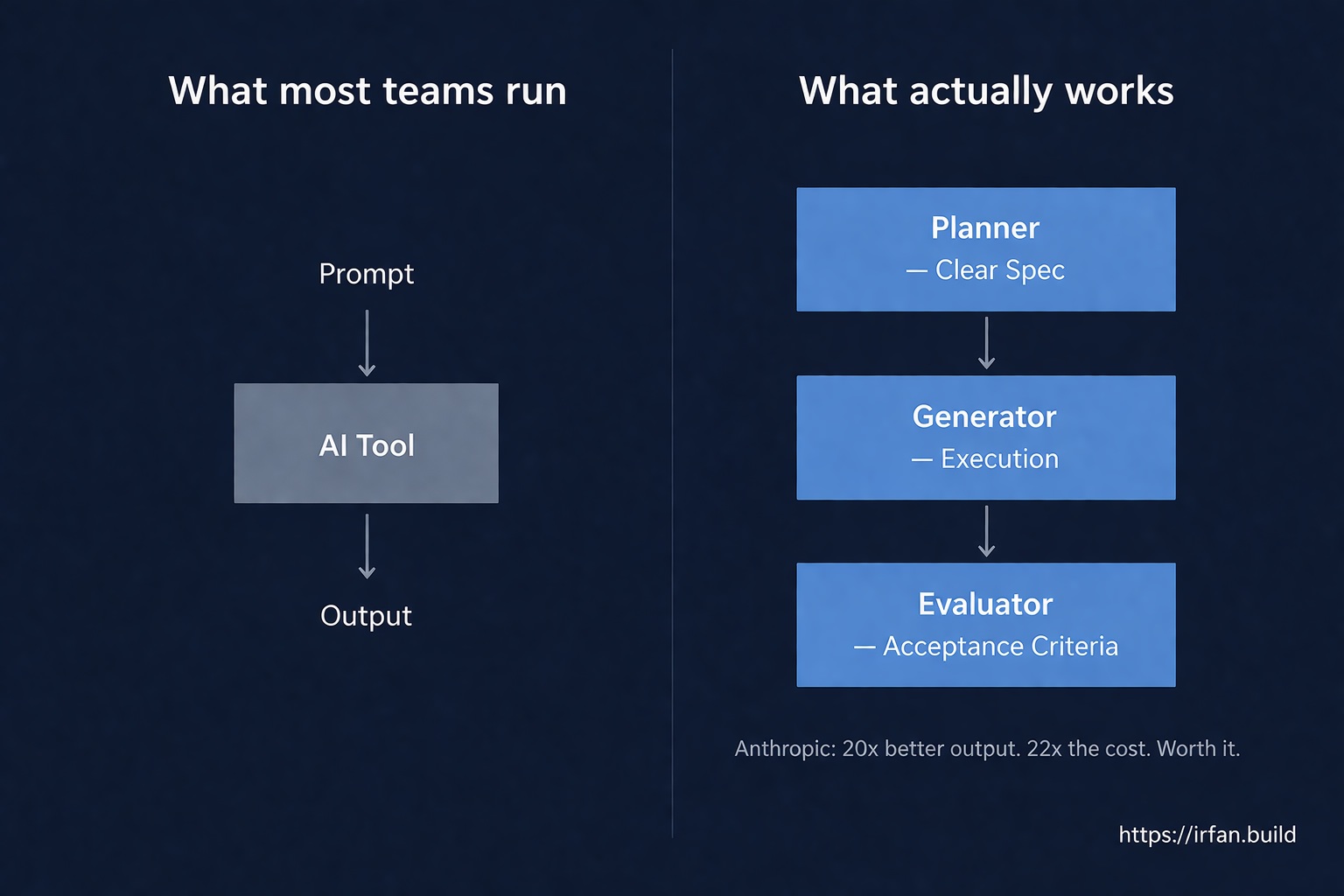
Anthropic's engineering team published a technical deep-dive on multi-agent harness design. What they actually published was an org chart, and it explains exactly why most AI initiatives produce underwhelming results.
ReadPrompt engineering is about what you say. Context engineering is about what you build. It is the emerging discipline that determines whether AI tools produce consistent, accurate output or confident-sounding nonsense.
ReadAI tools increased PR volume by 98% on some teams. Code review processes designed for human-paced output cannot handle that. The bottleneck is now review, not production, and the fix is not reviewing faster.
Read