How to Measure AI Adoption ROI on Engineering Teams
Most teams measure AI adoption with velocity and tool licences. Both metrics miss the point. Here are the six metrics that actually show whether AI is working for your team.
Most engineering teams measure AI adoption by counting tool licences and tracking sprint velocity. Both metrics are actively misleading. Tool licence counts tell you how many people have access to AI tools, not whether the tools are changing how work gets done. Sprint velocity tells you how fast the team is moving, not whether moving faster is creating value or creating risk.
The teams that get durable returns from AI adoption track a different set of metrics. They measure the system, not the tools. They track outcomes, not activity. And they set up their measurement baseline before rollout rather than trying to retrofit it after the fact.
This post covers the six metrics that actually tell you whether AI is working, how to set them up, and how to present the picture to non-technical leadership.
Why Velocity Is the Wrong Primary Metric
Velocity is a useful signal in a stable system. If your delivery process is healthy and your incident rate is low, faster velocity is genuinely better. AI tools that increase velocity in that context are creating real value.
The problem is that AI tools do not only affect velocity. They affect the entire production system. More code is produced, more PRs enter the review queue, more changes enter the codebase. If the rest of the system, review, testing, quality gates, has not been redesigned to handle higher volume, faster velocity is not better. It is a signal that a system designed for a certain throughput is now operating beyond its design capacity.
The 2026 State of AI Benchmark from Cortex.io documented this in aggregate: 20% more pull requests per engineer accompanied by 23.5% more incidents per pull request. The velocity gain was real. The system cost was also real, and it was not visible in the metric most teams were tracking.
Velocity should be in your AI adoption measurement. It should not be the primary metric. It should be paired with the metrics that show what the velocity is costing at the system level.
The Six Metrics That Actually Matter
Incident rate per release. This is the most important counterweight to velocity. Track how many incidents are associated with each release cycle and plot it against release frequency. If incidents per release are rising alongside velocity, the team is in the velocity trap: faster output entering a system that was not designed to handle more output. If incidents per release are flat or falling as velocity rises, the system is genuinely improving. No other metric tells you more clearly whether AI adoption is creating value or creating risk.
Change failure rate. Change failure rate measures what percentage of changes result in a failure that requires remediation. This is a more precise version of the incident rate question. A high change failure rate with high velocity means the team is producing changes that frequently require rework, which consumes the time that velocity gains created. The DORA metrics, which include change failure rate as a core measure, are the right framework here. Teams with genuinely AI-native engineering practices see change failure rates decline as velocity increases because the testing and review infrastructure catches more before production.
Review cycle time. Track the time from PR open to merge. This metric reveals whether the review process is scaling with output. When AI tools increase PR volume without changing the review process, review becomes the bottleneck. Cycle time increases. Senior engineers spend more time reviewing than engineering. The velocity gain in code production is absorbed by the review bottleneck and often does not translate into faster delivery of complete features.
If review cycle time is increasing as PR volume increases, the review process has not adapted. This is a diagnostic for whether the team has moved from AI-assisted to AI-native: an AI-native team has adapted its review processes to handle higher output volumes, and review cycle time stays flat or improves even as PR rate rises.
Senior engineer leverage ratio. This metric requires a bit of setup but is highly revealing. Track the ratio of senior engineer time spent on review and incident response versus engineering and architecture work. In a healthy AI-native team, this ratio should improve over time: AI tools handle more of the production work, senior engineers spend more time on architecture and capability building and less time firefighting or doing line-by-line review.
In an AI-assisted team, this ratio often goes the wrong direction. More code means more review. More incidents mean more firefighting. Senior engineers who should be doing high-leverage work are instead absorbed by the volume that AI tools have created without the system redesign to contain it.
Test coverage trend. Track test coverage as a percentage over time, but more importantly, track it against deployment frequency and incident rate. Rising coverage alongside rising deployment frequency is a strong signal that AI-native practices are working: agents or engineers are generating tests as part of their workflow rather than shipping code without coverage. Flat or falling coverage alongside rising deployment frequency is a warning that more code is entering the system than the test infrastructure is covering.
AI tool utilisation consistency. This is the one metric from the tool-adoption category that is worth tracking, but track it differently from simple licence counts. Measure consistency of use across the team rather than who has access. A team where 30% of engineers use AI tools heavily and 70% use them occasionally is not an AI-native team in any meaningful sense. An AI-native team has consistent, embedded practice across the whole team. Utilisation consistency is a leading indicator for whether coordinated AI-native practices have been established.
How to Set Up the Baseline Before Rollout
Measurement always tells a cleaner story when you have a pre-rollout baseline to compare against. The moment most teams reach for measurement is after rollout, when leadership asks for evidence of return on investment. At that point, you have no baseline and no way to separate the AI adoption signal from everything else that was happening at the same time.
If you are pre-rollout, set up your baseline now. Record your current incident rate per release, change failure rate, review cycle time, and test coverage. These four numbers are your starting point. You do not need sophisticated tooling for most of them: your incident management system, your PR analytics (GitHub or equivalent), and your coverage tool provide them.
If you are post-rollout without a baseline, the approach is different. You are looking for trend lines rather than before-and-after comparisons. Plot the metrics above over time and look for inflection points that correspond to when AI tools were adopted or when specific practices were changed. The trend line is less precise than a baseline but still informative, particularly if the inflection points are visible.
How to Present AI Adoption ROI to Non-Technical Leadership
The metrics above are meaningful to engineers and technical leaders. Presenting them to non-technical leadership requires translation.
The frame that works is risk-adjusted velocity. Start with the velocity story: here is how much faster the team is shipping. Then add the risk component: here is how the quality metrics are moving alongside velocity. If both are positive (faster and more stable), the case for AI adoption is strong and the business case is clear. If velocity is up but quality metrics are declining, you have a more honest conversation to have: the team is moving faster but accumulating risk that will show up as incidents and rework costs.
Non-technical leaders can engage with the incident cost argument directly. What is the average cost of a production incident in engineering time and business impact? If incident rate is rising 23.5% per release and the average incident costs four hours of senior engineer time plus whatever customer impact it creates, that is a calculable number. Putting it alongside the velocity gain gives leadership a real picture of the return.
The most important thing to avoid is presenting velocity-only data as the AI adoption story. Leaders who are given only velocity metrics make decisions based on incomplete information. When the incident cost shows up later, they cannot connect it to the AI adoption decision and the organisation loses the ability to learn from what happened.
The right posture is measurement from the start, presented completely. Teams that track and present the full picture, velocity and quality together, build more credibility with leadership than teams that present the positive signal and surface the negative signal only when it becomes undeniable.
The AI Engineering Maturity Assessment includes measurement of quality metrics as one of its six dimensions. It will tell you specifically whether your team's current measurement practices are aligned with AI-native standards, and what to add if they are not.
I help engineering teams close the gap between "we use AI tools" and "AI actually changed how we deliver." Book a 20-minute call and I'll tell you where the leverage is.
Thanks for reading.
Notes on AI-native products, platforms and operating models, from twenty years of building technology that pays its way. If this one landed, let's talk.
More writing
All writing →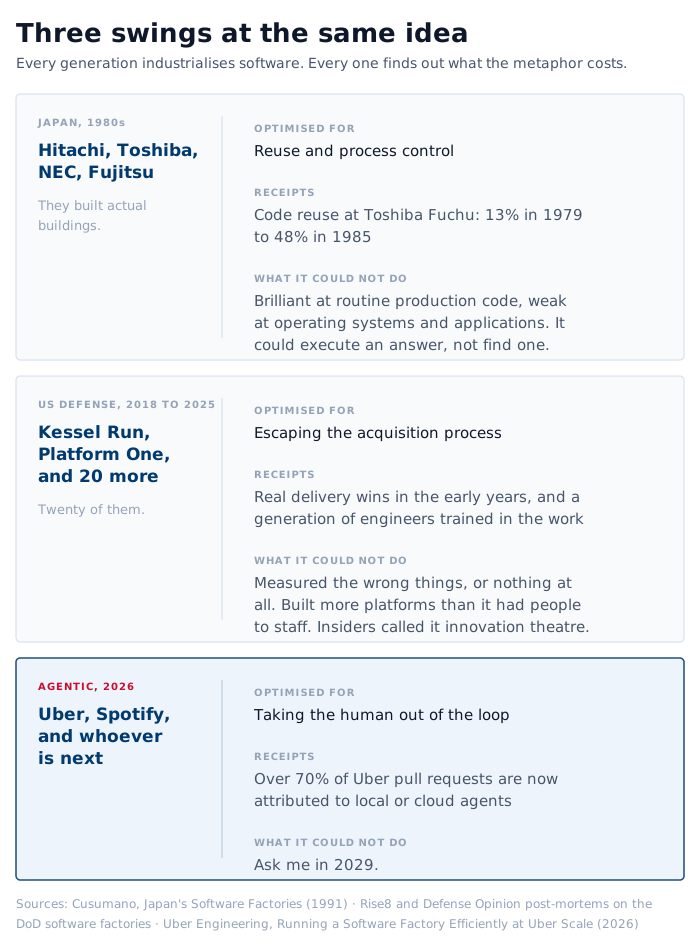
Software factories were tried in 1980s Japan and again across US Defense. Both fell short in the same way. The agentic version in 2026 is different in one specific respect, and it is not the agents.
Read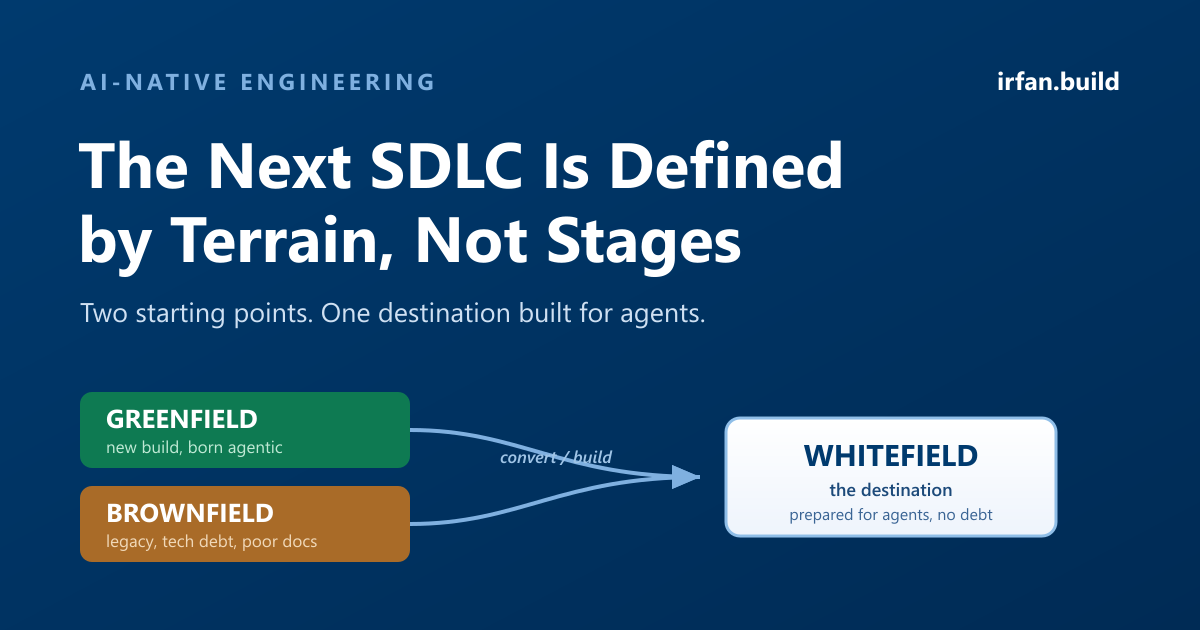
Most engineering teams are running AI on the wrong terrain. The Greenfield, Brownfield, WhiteField framework explains why results disappoint and what to change.
ReadAI-native engineering is not using AI tools. This guide covers what it means, the four capabilities required, and the L1-L4 maturity model that separates real transformation from tool adoption.
Read