Incremental vs. AI Transformation: What CTOs Actually Choose
Most CTOs frame this as a technology decision. It isn't. The choice between incremental AI and full transformation is determined by four business constraints, not technical preference.
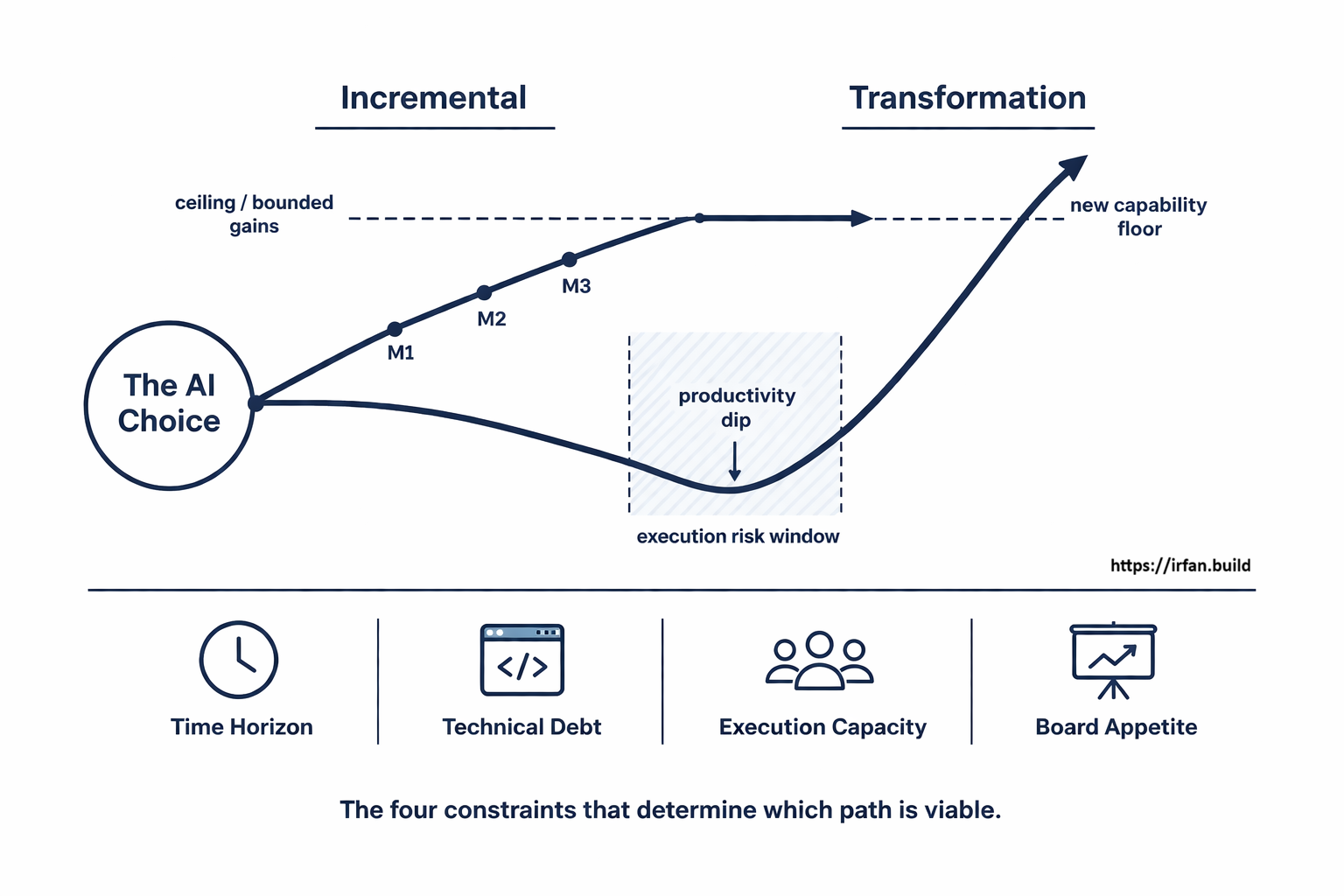
Most organizations treat the incremental versus transformation question as a technology question. They bring in analysts, run architecture reviews, evaluate build-versus-buy options, and debate which AI stack is most compatible with their current infrastructure.
They are asking the wrong version of the question.
The choice between incremental AI adoption and AI-native transformation is almost never determined by what the technology can do. It is determined by what the organization can survive. The four constraints that settle this question are business constraints, not technology preferences. Understanding them before commissioning any technical analysis is the difference between a decision and an expensive document.
The way this question usually gets framed
The standard framing goes like this: incremental means layering AI tooling onto what exists, preserving current architecture, keeping disruption low. Transformation means rebuilding for AI-native operations: changing architecture, team structure, and how work gets done.
Presented that way, it sounds like a risk tolerance question. Conservative organizations choose incremental. Ambitious ones choose transformation. The board decides how bold it wants to be, and the CTO executes the corresponding plan.
This framing is wrong in a specific, predictable way. It assumes that both options are equally available to the organization at the moment the question is being asked. In practice, at least two of the four constraints I am going to describe have usually already determined the answer before anyone has run a single architecture review.
The organizations that make this decision well are not the ones with better technology instincts. They are the ones that stop treating it as a technology decision early enough to ask the right questions.
What incremental actually means
Incremental AI adoption means adding AI capability to existing systems without changing the underlying architecture, team structure, or how decisions get made.
In practice: deploying AI coding tools for engineers, adding AI-powered features to existing products, automating specific manual workflows, bolting AI-generated recommendations into the current platform. The work is real. The gains are real. Teams move faster on the tasks they were already doing.
The advantages are genuine. Disruption is contained. Investment is smaller. The organization keeps delivering through the change. Risk is bounded because the blast radius of any single decision stays small.
The problem is that incremental adoption has a ceiling, and the ceiling is set by the existing architecture. If the current system was not designed for real-time, high-frequency, interconnected decision-making, no amount of incremental tooling will get there. You will gain productivity at the task level without changing what the business can do at the system level. Tickets close faster. Products ship marginally quicker. The core capability gap does not close, because the architecture was never designed to support what AI-native operations require.
The deeper problem is compounding. Organizations that choose incremental in year one tend to choose it again in year two, because the disruption threshold for transformation keeps rising as the business gets more dependent on what exists. The technical debt grows. The organizational habits calcify around the old architecture. The transformation that was manageable at eighteen months becomes a multi-year program at thirty-six months, and a potential existential event at sixty. The incremental path is not the safe path. It is often the path that delays the reckoning while making it more expensive.
What transformation actually means
Transformation is frequently misunderstood as a rewrite. It is not.
Rebuilding the technology stack is one component of transformation, and often not the most consequential one. AI-native transformation means changing how decisions get made, how teams are organized, and what infrastructure underpins execution. The technology architecture changes follow from the organizational changes, not the other way around. The teams that attempt technology-led transformation without the corresponding organizational change are the ones that end up with an AI-native platform staffed by teams organized for the old way of working. The technology is there. The business change is not. The results are proportional to the smaller of the two changes, not the larger.
Transformation has a specific organizational readiness requirement. The organization needs senior people who can hold delivery stable while the change runs. It needs leadership that can sustain commitment through the productivity dip that always arrives in the middle of a real transformation, because that dip is not a sign something has gone wrong. It is the normal cost of changing how a system works while it is running. And it needs a board that understands what it has funded well enough to not pull the funding when the dip arrives.
Without those conditions, transformation does not fail at the technology layer. It gets paused at month four or five when delivery drops visibly and someone in a leadership meeting says "we cannot afford to keep doing this right now." The pause becomes permanent. The architecture is half-changed. The team is demoralized and partially replaced. The next CTO inherits a codebase that is neither the old system nor the new one, with the worst properties of both.
I have seen this pattern more than once. The failure mode is not ambition. It is ambition without an honest assessment of what the organization can actually sustain.
The four constraints that determine the answer
These are the questions to answer before any technical analysis begins. The answers will usually tell you which path the organization can execute, regardless of which one leadership prefers.
Constraint 1: Time horizon.
How fast does the business need to compete differently? If a competitor is shipping AI-native capabilities that your current architecture cannot replicate in the next twelve months, incremental is not a strategy. It is a holding pattern that ends badly. If the competitive window is two to three years, incremental may buy enough time to fund and execute a properly resourced transformation without existential pressure.
The honest version of this question is not "how fast do we want to move?" It is "how fast does the market require us to move, and what is the business consequence of moving slower than that?" Most leadership teams answer the first version. The second version is the one that matters.
Constraint 2: Technical debt.
Can AI tools navigate your current architecture, or not? This is not a philosophical question about tech debt in general. It is a specific diagnostic: does the codebase have the properties that allow AI agents to work reliably?
Those properties are: documented architecture decisions, clear module boundaries, a test suite that produces actionable feedback, consistent conventions that automated tools can parse. A codebase without these properties can benefit from AI coding assistance at the individual engineer level. It cannot support agentic workflows or AI-native development at the team level. The technical debt determines the floor for what is possible. The ceiling can be raised. The floor is where you start.
Constraint 3: Execution capacity.
Does the organization have the senior people required to run a transformation without dropping delivery? This is the constraint that kills more transformations than any other, and the one that leadership is most likely to underestimate.
Transformation requires senior people doing two jobs simultaneously: keeping the existing business running while installing the new one. That capacity is always finite. It is always already committed to something. The question is not whether the organization wants to transform. It is whether it has people who can execute the transformation while the business stays stable enough to maintain board confidence.
Organizations that successfully execute transformation almost always have more senior capacity than average, because they invested in the talent layer before the transformation started, not while it was running. Trying to hire your way to execution capacity during a transformation is like changing a wheel while driving. It can be done. It is considerably harder than doing it with the wheel already on.
Constraint 4: Board appetite.
What will actually get funded, and for how long?
Transformation has a characteristic financial profile: investment front-loaded, returns back-loaded, productivity dip in the middle. That profile is hostile to quarterly-reporting pressure. If the board will fund eighteen to twenty-four months of change with a defined business case and clear milestones, transformation is viable. If the board expects to see ROI within two quarters, the financial structure of transformation will not survive first contact with the quarterly review.
This is not a question about board sophistication. It is a question about what has been communicated and agreed before the work starts. The conversations that need to happen at board level before the technical decision is made are not optional context-setting. They are the decision. If those conversations have not happened, the technical plan is a hypothesis, not a commitment.
What getting it wrong looks like
Choosing incremental when the constraints demand transformation.
The pattern: the organization adopts AI tooling across the board. Engineers are more productive. Specific workflows run faster. The gains are real and visible. Leadership feels like the transformation is happening.
Eighteen months later, a competitor ships a product that requires AI-native architecture to build at that price point and at that speed. The current architecture cannot replicate it without a rebuild. The organization is now facing a forced transformation under competitive pressure, with less runway than it would have had if it had started earlier and funded it properly. The window that existed is narrower. The technical debt is larger. The urgency is higher. Everything that made transformation manageable before has gotten harder.
The CTO who chose incremental was not wrong about what was achievable in year one. They were wrong about how much time the business had.
Choosing transformation when the constraints demand incremental.
The pattern: leadership commits to AI-native transformation. The architecture work begins. Delivery slows during the transition. The productivity dip arrives, which was predictable, but deeper than projected because execution capacity was overestimated and the senior people who were supposed to hold delivery stable were already overcommitted.
Six months in, a key delivery commitment is missed. The board asks whether the transformation is the cause. It is, in part. Funding for the transformation gets conditioned on delivery recovering first. Delivery cannot recover while the transformation is running. The transformation pauses. It does not restart. The architecture is caught between two states. The team is split between people who believed in the change and people who knew it would not work, and the second group now has evidence.
The CTO who chose transformation was not wrong about what the business needed. They were wrong about what the organization could sustain, and they found out at the worst possible time.
The decision framework
The right question is not "which path is better?" Both produce good outcomes in the right conditions. The right question is: given these four constraints, which path can this organization actually execute?
If time horizon is short and technical debt is high: Neither pure path works cleanly. The rational move is usually a targeted transformation of the highest-value, most AI-sensitive part of the system, while the rest of the business continues incrementally. This requires being explicit about which parts of the business are being transformed and which are not, rather than announcing transformation and delivering incremental. The first produces a coherent plan. The second produces confusion about why the transformation is not producing results.
If time horizon is long and technical debt is manageable: Incremental may be the rational choice. The key discipline is being honest about the ceiling: what this path will not be able to produce, and at what point the organization will need to make a different decision. Incremental without a defined upgrade point becomes a permanent constraint.
If execution capacity is constrained: Scale the ambition to match the capacity. An incremental plan that the organization can actually execute beats a transformation plan that stalls at month four. The question is never "which plan is better in theory?" It is "which plan can we execute with what we actually have?"
If board appetite is short: Restructure the business case before starting. A transformation that runs out of runway halfway is worse than incremental. The financial model and the organizational commitment need to be in place before the technical work begins. That is a leadership conversation, not a technology conversation.
The question that precedes the decision
The organizations that navigate this well separate the strategic question from the technical one. The strategic question: what does the business need, and what can the organization sustain? The technical question: given that answer, what does the architecture need to look like?
Running them in the wrong order is how organizations end up with a technically sophisticated recommendation that cannot be funded, cannot be staffed, and cannot be executed. The architecture review becomes a document rather than a decision because the business case was never settled before the technical analysis began.
The right sequence is: settle the four constraints first. Understand which path they make viable. Then commission the technical analysis to define what that path looks like in your specific environment, with your specific systems, your team, and your competitive timeline.
The technology will tell you how. The constraints will tell you which.
This is the decision I work through in the AI Architecture Review: a structured week working through your architecture, your organizational readiness, and your business constraints, ending in a clear recommendation you can present to your board. If you are working through this question now, book a call and we can establish in thirty minutes whether the review is the right next step.
Thanks for reading.
Notes on AI-native products, platforms and operating models, from twenty years of building technology that pays its way. If this one landed, let's talk.
More writing
All writing →Singapore's growth-stage companies are well-funded and technically ambitious. The technology leadership gap they face is not about capability in the market. It is about finding the right engagement at the right stage.
ReadMalaysia's growth companies face a specific technology leadership gap: too early for a full-time CTO, too complex for a part-time advisor. Here is what the right engagement looks like and how to evaluate it.
ReadAI changed what execution costs. It did not change what leadership requires. But it did change what leadership looks like, and most engineering leaders have not yet made that adjustment.
Read