How Engineering Leaders Should Evaluate AI Coding Tools
Most AI coding tool evaluations are run by individual developers and optimised for developer experience. That produces a different answer than an evaluation optimised for team outcomes. Here is how to run the right evaluation.
Most AI coding tool evaluations follow the same pattern. A few developers try the tool for a sprint. They report back on whether they liked it. The tool gets adopted or rejected based on that feedback. The evaluation was conducted by the people whose experience most benefits from the tool, measuring the dimension most likely to produce a positive result, and producing a recommendation that reflects individual productivity rather than team outcomes.
This is not a bad process for selecting a code editor. It is a flawed process for selecting a tool that will change how your entire engineering team produces software.
The gap between developer experience and team outcome is wider for AI coding tools than for almost any other category of engineering tool. A tool that makes individual developers feel more productive can simultaneously be increasing your change failure rate, degrading your code review quality, and building technical debt at a rate that will surface as incidents six months from now. None of that shows up in a sprint retrospective.
This post is about how to run an evaluation that measures what actually matters.
Why Developer Experience Is the Wrong Primary Signal
Developer experience is a legitimate input to an AI tool evaluation. It is not the primary signal.
The problem is that the things developers experience as friction are often the things that protect quality. A tool that removes the friction of reading code before modifying it is a tool that is also removing a quality gate. A tool that generates tests automatically is pleasant when the generated tests pass and invisible when they test the wrong things. A tool that speeds up code production is good news and bad news simultaneously, depending on whether the system receiving that code is ready for it.
The developer who runs your evaluation will tell you that the tool is fast, responsive, and generates plausible code with minimal prompting. They will not tell you whether the generated code fits your architecture, whether it introduces subtle coupling that will become a maintenance problem, or whether it is producing more code for your reviewers to process than your review culture can handle. Those outcomes take time to surface and they do not show up in a two-week trial.
The evaluation framework that works asks different questions at a different level.
The Four Dimensions That Actually Predict Team Outcomes
Output quality at system level, not line level. The right question is not "does the generated code work" but "does the generated code fit." Fit means architecturally consistent with the decisions already made in the codebase, convention-correct, dependency-appropriate, and maintainable by someone who did not write it.
Testing this requires reviewers who know the codebase well and are evaluating generated output against the actual system, not against abstract quality criteria. A senior engineer who reviews twenty AI-generated PRs with fresh eyes can tell you whether the output fits the system. A developer who is excited about their productivity gain cannot tell you the same thing objectively.
Review load before and after. Measure the time your reviewers spend per PR before the trial and during it. AI tools consistently increase the volume of code entering the review queue. Whether they increase or decrease the review load per engineer depends entirely on whether the generated code is consistently high quality and whether your review process has adapted to the new volume.
Teams that find AI tools valuable at the team level have review loads that either stayed flat or decreased per engineer. Teams that find AI tools creating problems have review loads that increased, often substantially, because generated code requires more explanation, more correction, and more architectural pushback than handwritten code did.
Quality metric baseline and delta. Before starting any AI tool evaluation, set a baseline. Record your current change failure rate, your incident frequency, your mean time to recovery. Run the evaluation. Check the delta.
Most organisations skip this step because it requires instrumentation that most teams do not have. Building that instrumentation is the prerequisite for evaluating AI tools honestly. Without a baseline, you can observe that velocity went up and call the evaluation a success. With a baseline, you can also observe whether incidents went up and decide whether the trade-off is worth it.
Context infrastructure compatibility. Different tools work better with different levels of codebase context infrastructure. A tool that relies heavily on local inference will perform better in small, well-structured, consistent codebases than in large legacy systems. A tool with strong CLAUDE.md or workspace rule support will perform better when you have invested in context documentation.
Before choosing a tool, understand where your codebase sits on the context infrastructure spectrum. A team with poor context infrastructure will get mediocre results from any tool and should invest in infrastructure before tool selection, not use tool selection as a substitute for it.
The Questions to Ask Before Shortlisting
Before running any trial, three questions narrow the field faster than any feature comparison.
What is the primary unit of work in your engineering workflow? If your developers spend most of their time on well-defined, bounded tasks in a relatively consistent codebase, inline completion tools like Copilot will give good returns. If they spend most of their time on complex, multi-file changes that require reasoning about system architecture, agentic tools like Claude Code will give better returns. If they spend significant time reading and understanding code before writing it, IDE-integrated tools like Cursor fit the workflow better.
Most teams need different tools for different use cases. The question of "which tool" is often the wrong question. The right question is "which tool for what."
How invested are you in context infrastructure? Tools that support deep context configuration, CLAUDE.md, workspace rules, skills libraries, and hooks produce significantly better output when that infrastructure is in place. If your codebase has minimal context documentation, the gap between a heavily-configurable tool and a simpler one is much narrower. The return on investing in a sophisticated tool depends on the return on investing in the infrastructure it needs.
What is your current review process, and can it handle more volume? If your team already has tight review bandwidth, any tool that increases PR volume without also improving the quality per PR will make things worse. Before adopting any AI coding tool at scale, assess whether your review process can handle the volume increase. If it cannot, fix the review process first.
Running the Evaluation
A credible evaluation needs four to six weeks, not two. The failure modes of AI tool adoption take longer than two weeks to surface. A four-week evaluation catches more of them.
Structure the evaluation in three phases.
Phase 1 (week one to two): Baseline and setup. Record quality metrics. Set up context infrastructure for the tool being evaluated. Give developers the configuration they need to use the tool properly. Do not evaluate a tool with minimal configuration; you are evaluating the tool, not your laziness about setting it up.
Phase 2 (week two to four): Active use with measurement. Developers use the tool normally. Track PR volume, review time per PR, incident rate, and test coverage changes. Have senior reviewers do spot checks on AI-generated output specifically, evaluating architectural fit rather than line-level quality.
Phase 3 (week four to six): Assessment and decision. Compare quality metrics to baseline. Assess review load changes. Evaluate whether the output fit the system. Make a decision based on what the data shows, not on how enthusiastic the developers are.
The Decision Framework
If quality metrics improved or held flat, review load did not increase significantly, and generated output fitted the system: adopt and invest in configuration and context infrastructure.
If velocity metrics improved but quality metrics degraded: you are in the velocity trap. Do not adopt at scale until you have fixed the foundations that the tool exposed.
If the tool performed inconsistently across different parts of the codebase: this is usually a context infrastructure problem, not a tool problem. Invest in context infrastructure and re-evaluate.
If developers liked the tool but senior reviewers found the output did not fit the system: trust the senior reviewers. Developer enthusiasm is a necessary but not sufficient condition for adoption.
The tools that survive this evaluation framework are tools that are genuinely making your engineering system better. The ones that do not survive were making individual developers feel more productive while building risk into the system. Both are common outcomes. Only one of them is a good investment.
I help engineering teams close the gap between "we use AI tools" and "AI actually changed how we deliver." Book a 20-minute call and I'll tell you where the leverage is.
Thanks for reading.
Notes on AI-native products, platforms and operating models, from twenty years of building technology that pays its way. If this one landed, let's talk.
More writing
All writing →AI changed what execution costs. It did not change what leadership requires. But it did change what leadership looks like, and most engineering leaders have not yet made that adjustment.
Read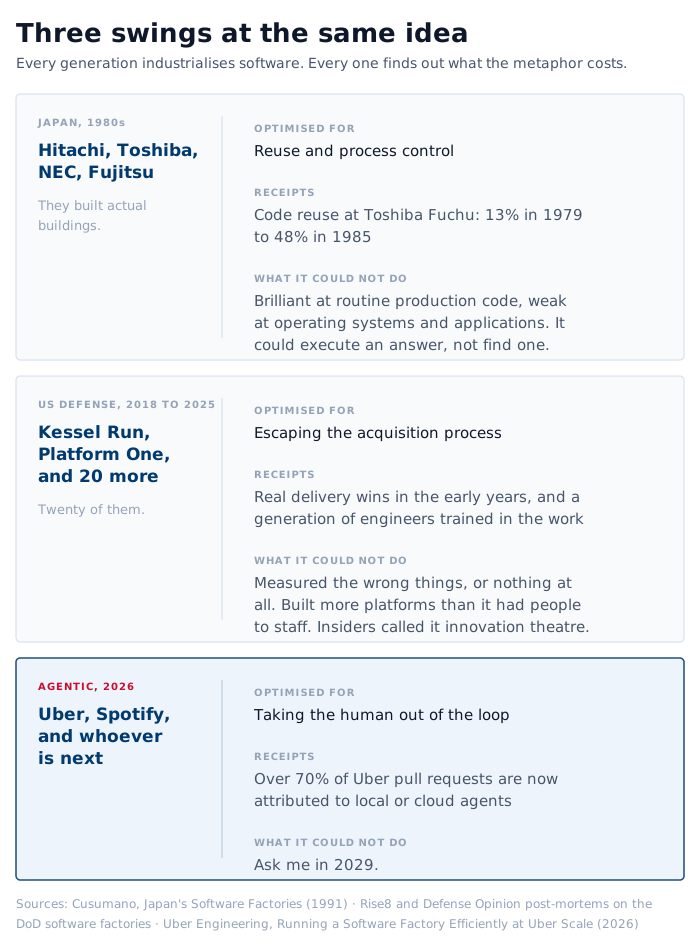
Software factories were tried in 1980s Japan and again across US Defense. Both fell short in the same way. The agentic version in 2026 is different in one specific respect, and it is not the agents.
Read
Most engineering orgs added AI but kept the rituals built for a slower era. Here are eleven things to retire this quarter, and what to replace them with.
Read