The Forward Deployed Engineer
Palantir built a role in 2015 that most companies had never heard of. One engineer, full ownership, deployed directly into the client's problem. AI didn't create the role. It made it possible at scale.
In 2015, Palantir built a role that most companies had never heard of and would have struggled to justify in a hiring committee. They called it the Forward Deployed Engineer.
The idea was structurally unusual: take a software engineer, put them directly inside the client's environment, give them full ownership of the problem, and have them build the solution on-site. Not a consultant who makes recommendations. Not a solutions engineer who demos the product. A builder who owns the outcome, end to end, in the client's actual conditions.
The role never scaled widely. The constraint was obvious: implementation was expensive, and engineers who could operate at that level of autonomy were rare. You could not send one to every client.
AI changed that constraint. The role is becoming viable at a scale Palantir could not have built it for in 2015. Most companies do not know they are already trying to produce it.
What the Forward Deployed Engineer Actually Does
The FDE is not a consultant. Not a senior developer who attends client calls. Not a PM who can also write code.
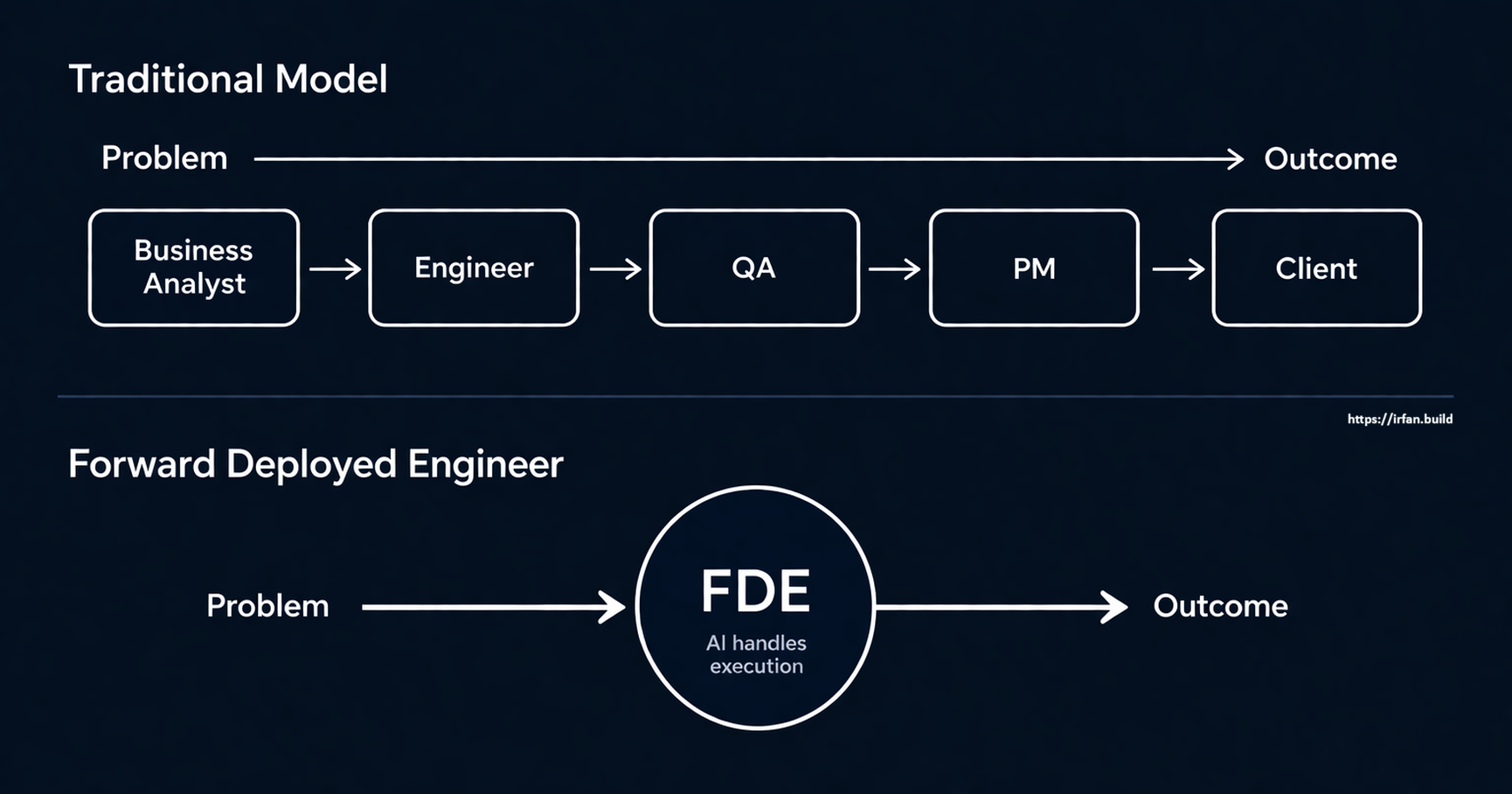
The FDE owns the outcome, end to end. They sit with the client long enough to understand the real problem, not the version of it that made it into a requirements document. They build the solution, often with real data, in the client's actual environment. They validate whether it worked. They adjust. They leave when the thing is running and the team can maintain it.
The model is closer to a doctor than a software developer. A doctor does not write specifications for a patient and hand them to a pharmacist to fill. The doctor assesses, decides, treats, and checks. Accountability runs through one person from diagnosis to outcome.
That is what the FDE does. One person accountable for the diagnosis, the build, and the proof that it worked. No handoffs. No distributed accountability. One name on the outcome.
Why This Model Did Not Scale Before AI
The execution bottleneck made the FDE expensive.
To own a problem end to end, you need to be able to build. Before AI, building was the slow part. A single person with full ownership still needed weeks to produce something meaningful at production quality. At that pace, you could serve a small number of clients before your best engineers were fully consumed.
The alternative was specialization: a business analyst for requirements, engineers for implementation, QA for testing, a PM for coordination. This model was cheaper per hour and slower per outcome, but it was the only structure that scaled. You could staff it without producing one exceptional person per client.
Most software organizations still run this model. Not because it is optimal, but because it was the only structure that made sense when execution was expensive and ownership could be distributed across specialists without the outcome visibly suffering.
AI Changed the Economics
An FDE with AI can produce in a day what previously took a week. Not because the judgment is easier, but because the gap between a clear intention and working software is smaller.
The FDE still needs to understand the problem. Still needs to make the architectural call. Still needs to know when the model output is wrong. None of that got easier. What got easier is turning a well-defined intention into working code fast enough to validate against real conditions before a week has passed.
This changes the unit economics of the role. A single person with strong judgment and AI as an execution layer can serve multiple clients at a depth that previously required a team. The FDE model, which could not scale when implementation was the constraint, becomes viable when implementation gets cheap.
Palantir's version of this role required exceptional people operating in a high-intensity deployment model. The AI-native version of this role requires strong judgment, technical range, and the discipline to own an outcome. The bar is high, but it is reachable by more people.
Why Most Organizations Cannot Produce This Role
The FDE requires a capability that most engineering organizations have systematically under-developed: the ability to own an ambiguous problem from discovery through production without handing it off.
Most engineers have never done this. Not because they are not capable, but because the system was not designed for it. Specialization made sense when execution was expensive. You hired people to do specific parts of the work well, and coordinated the parts. Accountability was clean because responsibility was bounded.
When you try to produce an FDE from that system, you get one of two things. A senior engineer who is technically strong but uncomfortable with problem ownership and client-level ambiguity. Or a consultant who is comfortable with client work but cannot build.
The FDE is both. And producing both in the same person requires designing for it deliberately: assigning problems to own, not tasks to execute; putting engineers in proximity to real user problems instead of behind a layer of requirements translation; and measuring accountability to outcomes, not output.
Most organizations are not doing this. They are measuring velocity, not whether the velocity is pointed at the right thing.
What It Takes to Be One
Three capabilities define the FDE archetype, and all three are difficult to develop in a task-based organization.
The first is problem fluency: the ability to sit with a real business problem, without a spec, and develop a credible hypothesis about what to build and why. This requires access to real users, tolerance for ambiguity, and the discipline to resist building before the problem is understood. Engineers who have only worked from tickets struggle here. The ticket already contains someone else's hypothesis.
The second is technical range: not necessarily the deepest specialist in any one area, but broad enough to own the full stack of a solution without needing to hand off to another function. With AI, the depth requirement per domain is lower than it used to be. The range requirement is not.
The third is ownership disposition: the willingness to be accountable for whether the thing worked, not just whether the thing was built. This is rarer than it sounds. Most engineers have been trained to own the PR. The FDE owns the outcome. The pull request is not the finish line. It is the halfway point.
These capabilities do not emerge from hiring alone. They develop through the kind of work you assign and the kind of accountability you build into the role over time.
The Template Is Already Spreading
Palantir built this role when AI was nowhere near where it is today. They built it because they understood that complex client problems are not solved by handoffs. They are solved by ownership.
AI raised the ceiling on what one person can produce. It did not solve the ownership problem. The FDE model works because the person owns the outcome. AI makes it possible to own more of it, faster.
The organizations producing the strongest engineers right now are designing roles that develop ownership, not roles that optimize handoffs. They are putting engineers in contact with real problems, measuring them on outcomes, and building the expectation that one person can carry the problem from discovery to production.
The name is Palantir's. The archetype is becoming the template for what strong engineering looks like in an AI-native organization.
If you are building an engineering organization and you are not asking "who owns this outcome end to end?", you are building for a constraint that no longer exists.
I help engineering teams close the gap between "we use AI tools" and "AI actually changed how we deliver." Book a 20-minute call and I'll tell you where the leverage is.
Thanks for reading.
Notes on AI-native products, platforms and operating models, from twenty years of building technology that pays its way. If this one landed, let's talk.
More writing
All writing →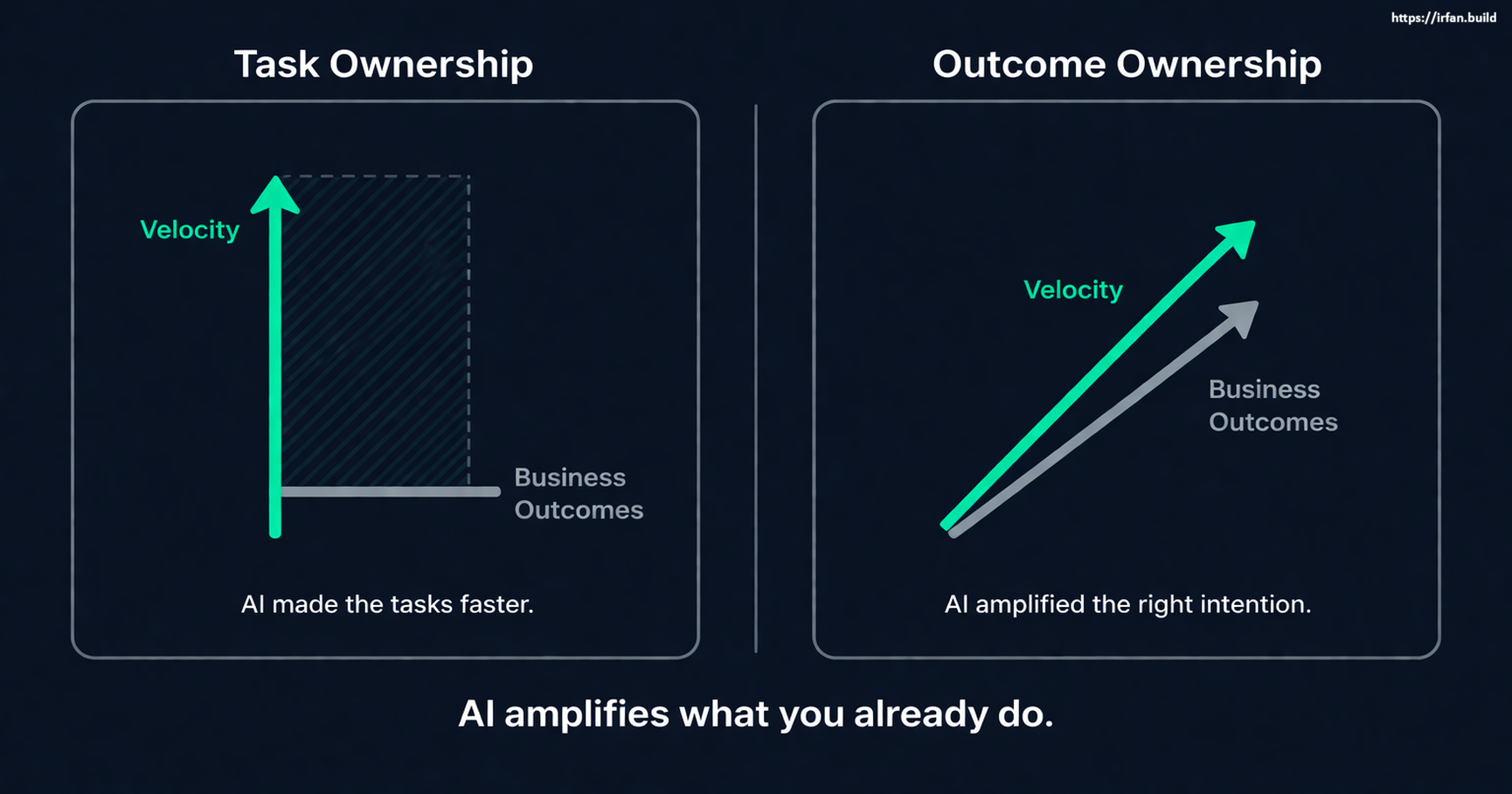
Teams frustrated with AI ROI share a common pattern. The tools are working. The work is getting done faster. The business outcomes have not changed. That is not a tools problem.
ReadWhen building gets cheap, the bottleneck moves to problem discovery and outcome ownership. The PM who writes tickets gets exposed. The PM who owns the outcome gets stronger.
ReadAI requirements planning doesn't fix vague specs, it accelerates them. Teams now build the wrong thing faster, with more confidence, at a higher cost to undo.
Read