Moving an Engineering Team from L2 to L3: A Playbook
L3 AI maturity is achievable in four to twelve weeks. Most teams do not get there because they try to do everything at once. Here is the sequence that works.
L3 AI maturity is achievable for most engineering teams in four to twelve weeks, depending on repo size, regulatory load, and domain. Most teams do not reach it not because the work is too hard but because they approach the transition without a sequence. They try to implement context infrastructure, rebuild the test suite, write review standards, and coordinate team workflows simultaneously. The combination is overwhelming, progress stalls on all fronts simultaneously, and the team concludes the transition is harder than it is.
The sequence matters. Each capability builds on the one before it. Context infrastructure makes test rebuilding faster because you know what the tests need to reflect. Test infrastructure makes review standards more concrete because you know what quality actually looks like in your system. Written review standards make team workflow coordination easier because the standards tell everyone, including AI tools, what is expected. Done in order, each step accelerates the next.
This post gives you the specific sequence and the approximate timeline for each stage.
Why Most Teams Stall at L2
L2 is comfortable. AI tool adoption is high, individual engineers are productive, velocity metrics look good, and leadership is pleased with the rollout. The incentive to push further is low precisely because L2 produces visible wins that are easy to celebrate and report.
The cost of L2 is invisible until it is not. Incident rate climbs gradually. Review cycle time increases as PR volume grows. Senior engineers find themselves spending more time on review and firefighting and less on architecture. The team attributes these costs to growth and complexity rather than to AI amplifying an engineering system that was not redesigned for higher volume.
The move to L3 requires acknowledging that the L2 wins are real but incomplete. Velocity is up because individual engineers are more productive. But the system those engineers work in has not changed, and a system designed for human-speed production is now running at AI-assisted speed. The gap between production speed and system capacity is where the cost accumulates.
The teams I have worked with that successfully made the L2-to-L3 transition all shared one characteristic: a leader who was willing to make the case for the transition before the system pain was undeniable. They made the investment when it was optional rather than waiting until it was urgent. That patience is difficult to maintain when L2 metrics look good. It is also what separates teams that reach L3 cleanly from teams that reach L3 after an incident that forced the issue.
Stage One: Context Infrastructure (Weeks 1-2)
Start here regardless of what else looks urgent. Context infrastructure is the foundation for everything that follows, and it is the fastest stage to complete.
The deliverable for Stage One is a CLAUDE.md in the root of the repository that is accurate, specific to your system, and reviewed by the two or three engineers who know the codebase best. The file does not need to be comprehensive. It needs to be correct on what it covers: what the system does, how it is organised, what the key conventions are, what the constraints are.
Alongside the CLAUDE.md, write architecture decision records for the three to five most significant decisions in the codebase. An architecture decision record is not long: problem statement, decision made, reasoning, and alternatives considered. The value is not the length. The value is that the reasoning behind key decisions is now in the system rather than in individuals' heads.
Two weeks is enough to complete Stage One if the work is treated as a focused effort rather than squeezed into normal sprint work. The CLAUDE.md takes a focused half-day to draft and a full team review session. The architecture decision records take an hour each to write once the engineer who owns that area sits down to do it.
How to know Stage One is complete: open an AI coding tool, give it a task in a less-familiar part of the codebase, and check whether the output reflects the conventions and constraints you documented. If it does, the context infrastructure is working. If it does not, the CLAUDE.md needs to be more specific about the areas where the output diverged.
Stage Two: Test Infrastructure Audit (Weeks 3-5)
The goal of Stage Two is not to rewrite the test suite. It is to audit the existing suite for agent-readiness and make targeted improvements in the highest-risk areas.
Agent-readiness has a specific meaning. A test suite is agent-ready when the feedback it gives is specific enough that an agent or engineer can understand what broke and why, not just that something broke. Vague test failure messages, tests that fail at too high a level to isolate the cause, and coverage gaps in areas where agents are most likely to introduce changes are the three things to address.
Run a coverage audit first. Where is coverage lowest? Map that against where AI tools are most likely to work: typically the areas with the most recent activity and the areas at the boundary between major components. Those are your highest-risk areas for agent-introduced regressions, and those are where you invest first.
Then run a test quality audit on the areas you are going to improve. Read the test failure messages. If a test fails, would you know from the message alone what to fix? If not, improve the message. This is unglamorous work. It is also high-leverage: an agent that can read a clear failure message and understand what to fix closes the feedback loop that makes agentic workflows viable.
Three weeks is enough to complete Stage Two at a meaningful level if the focus is on targeted improvement rather than comprehensive coverage. You are not trying to achieve perfect test coverage. You are trying to make the test suite useful for agents working in the areas of highest activity. The remainder of coverage improves over time as tests are added to every new piece of work.
Stage Three: Review Standards and Quality Metrics (Weeks 6-8)
Stage Three is about capturing implicit knowledge explicitly and establishing the measurement baseline that tells you whether the transition is working.
Written review standards exist in almost every engineering team as implicit knowledge held by senior engineers. The seniors know what a good PR looks like. They know which architectural decisions require escalation. They know which categories of change require deep review versus a quick scan. They apply this knowledge in review, but they have never written it down.
At L3, these standards need to be explicit. Not because engineers cannot ask, but because AI tools cannot ask. When an agent produces a PR, it cannot ask "does this need a deeper review?" The written standard either tells it, or it makes the call based on local inference. The written standard is more reliable.
The format does not need to be elaborate. A checklist that senior engineers would use for PR review, combined with a short description of what categories of change require what depth of attention, is enough. Write it collaboratively with the senior engineers on the team. Their implicit standards are the content. You are just making them explicit and findable.
Alongside the review standards, establish your quality metrics baseline: incident rate per release, change failure rate, review cycle time. These numbers will tell you over the next three to six months whether the L3 transition is delivering what it should. Establish them now so you have a baseline to compare against.
Stage Four: Team Workflow Coordination (Weeks 9-12)
Stage Four is where individual AI-native practices become a team-level system. The goal is consistent, coordinated AI use across the team rather than high adoption among some engineers and low adoption among others.
Coordinated practice at the team level means three things: a shared understanding of how AI tools should be used in different stages of the development workflow, a shared set of context files and prompts that the whole team uses, and a review of how the team's AI workflows interact (so two engineers working in the same area are using compatible approaches).
The most common failure mode at this stage is trying to standardise everything at once. Pick two or three workflows where consistency matters most, standardise those, and let the rest evolve. PR description generation is an easy start: a shared prompt that every engineer uses for PR descriptions ensures consistency and reduces review cognitive load. Context file conventions are a natural second: if every engineer knows how to extend the CLAUDE.md and how to add local context files for specific components, the context infrastructure grows organically with the work.
By the end of Stage Four, you have the four capabilities of AI-native engineering operating together: context infrastructure, agent-ready tests, explicit review standards, and quality measurement. The team is at L3.
How to Know You Have Actually Reached L3
L3 is not a certificate. It is a state of the system. Three signals confirm you have reached it.
First: a senior engineer taking two weeks off does not create visible disruption. The context is in the system, the standards are written, the quality gates run without them.
Second: incident rate per release is flat or declining despite higher PR volume. The system is absorbing the output AI tools create without proportionally higher failure rates.
Third: new engineers or new AI agents working in unfamiliar parts of the codebase produce output that fits the system. The context infrastructure is working.
The AI Engineering Maturity Assessment measures all six dimensions of AI-native maturity and tells you specifically where you sit on the L1-L4 model. If you have completed the stages above and want a third-party read on where your team actually is, the assessment is the right tool.
I help engineering teams close the gap between "we use AI tools" and "AI actually changed how we deliver." Book a 20-minute call and I'll tell you where the leverage is.
Thanks for reading.
Notes on AI-native products, platforms and operating models, from twenty years of building technology that pays its way. If this one landed, let's talk.
More writing
All writing →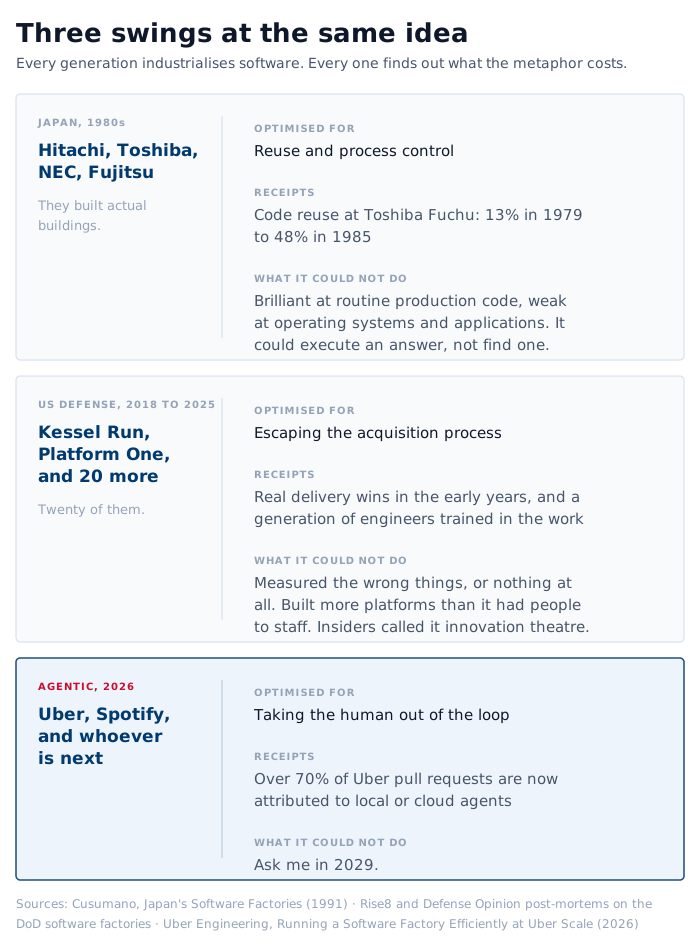
Software factories were tried in 1980s Japan and again across US Defense. Both fell short in the same way. The agentic version in 2026 is different in one specific respect, and it is not the agents.
Read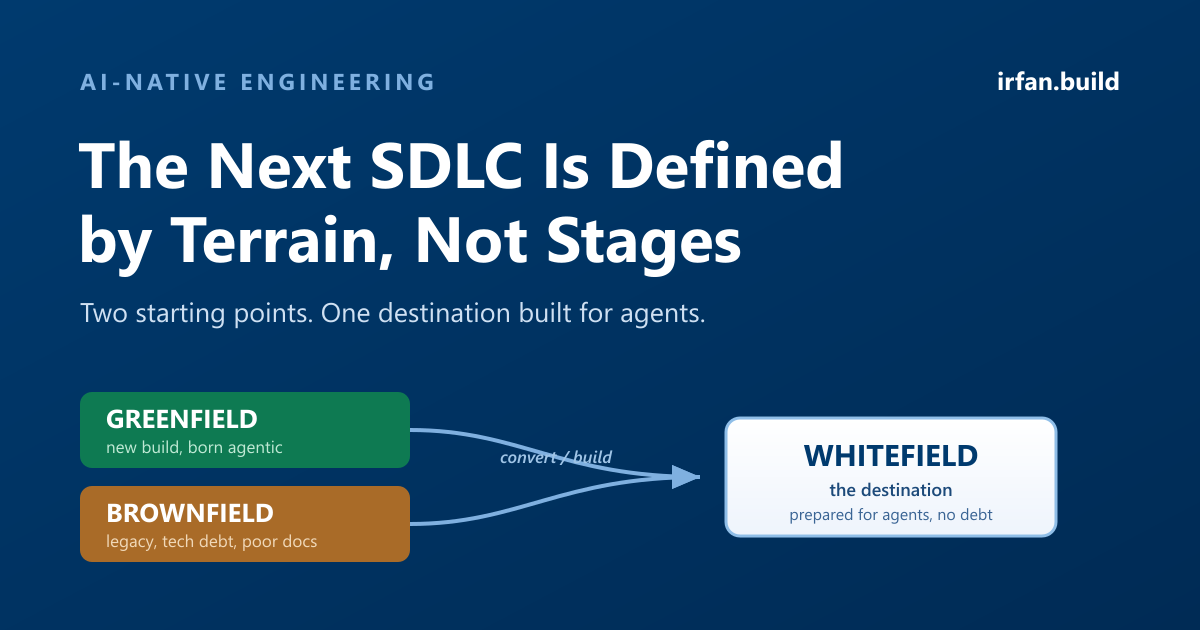
Most engineering teams are running AI on the wrong terrain. The Greenfield, Brownfield, WhiteField framework explains why results disappoint and what to change.
ReadAI-native engineering is not using AI tools. This guide covers what it means, the four capabilities required, and the L1-L4 maturity model that separates real transformation from tool adoption.
Read