What Engineering Leadership Actually Means in the Age of AI
AI changed what execution costs. It did not change what leadership requires. But it did change what leadership looks like, and most engineering leaders have not yet made that adjustment.
Engineering leadership has always been about making the system produce good outcomes, not about personally producing good code. The best engineering leaders understood this before AI. What AI has done is make that principle impossible to ignore, because the old proxy for leadership quality, being technically impressive in the room, has been devalued faster than most leaders have recalibrated.
A senior engineer who can write elegant code in three languages, debug production incidents from first principles, and design distributed systems from scratch is still valuable. That combination of capabilities is also no longer the primary differentiator it was five years ago. AI tools have made parts of that skill set more widely available, faster, and cheaper. The parts of engineering leadership that AI cannot replicate are coming into sharper relief.
This post is about what those parts are, what they require in practice, and where most engineering leaders are currently underinvesting.
What AI Cannot Do at the Leadership Level
The productivity narrative around AI focuses on individual contributors: developers writing more code faster, completing tickets in hours instead of days. That narrative is accurate and it misses the more important story.
The more important story is about what AI has exposed in engineering leadership. When AI tools generate code at speed, the bottlenecks that slow everything down become visible in a way they were not before. Those bottlenecks are almost never technical. They are organisational: unclear ownership, ambiguous specifications, undocumented decisions, review processes that were never designed to handle current throughput.
These are leadership problems. AI makes them more expensive more quickly, but it did not create them. They were there before. The engineering leader who built a team where AI amplifies dysfunction is dealing with a leadership problem they were already carrying.
What AI cannot do: define what the system should be, decide what to build versus what to defer, maintain the context and coherence that makes a large engineering system navigable, create the conditions where engineers do their best work, evaluate whether the direction is right when the execution is fast. These are judgment capabilities. They scale with experience and deliberate development. They do not get cheaper or faster when compute does.
The Shift That Engineering Leaders Are Missing
Most engineering leaders are responding to AI adoption in one of two ways. The first is enthusiasm: adopt the tools, celebrate the velocity gains, move on. The second is resistance or ambivalence: the tools are inconsistent, the output needs too much correction, the quality is uncertain.
Both responses miss the more significant adjustment. The tools are not the point. The question is what the tools reveal about the system you are running, and what you intend to do about it.
Teams that got durable gains from AI adoption did not just install the tools. They used the adoption as an opportunity to address infrastructure debt they had been carrying: context infrastructure that did not exist, review processes that were informal and inconsistent, test coverage that was aspirational, ownership that was implicit. They built the foundations that AI tools need to work reliably, and in doing so built the foundations that the team needed to work reliably regardless of AI.
The engineering leader who did this treated the AI adoption as a systems design problem: what does this team need to look like for AI tools to amplify good outcomes rather than bad ones? That question is a leadership question. It is also the right question, independent of AI.
Three Things Engineering Leaders Now Need to Do Differently
Make context infrastructure a first-class concern. Before AI, the cost of implicit knowledge was relatively low. A senior engineer who knew why certain architectural decisions were made, where the bodies were buried, which modules were risky: that knowledge lived in their head, and the team absorbed it informally over time. New engineers spent months picking it up.
AI tools cannot absorb implicit knowledge. They work from what is documented. An engineering leader who does not invest in making the system's knowledge explicit, in CLAUDE.md files, architecture decision records, module-level context documentation, is not just paying a productivity tax. They are making AI tools less effective in direct proportion to how much institutional knowledge lives only in people's heads.
This is not a tooling decision. It is a leadership decision about what kind of knowledge infrastructure the team will maintain. The teams that are furthest ahead on AI adoption have leaders who made this decision deliberately, often before they had the full picture of what AI adoption would require.
Reframe what good engineering looks like. The proxy for engineering quality most leaders use is code output: PRs merged, features shipped, velocity sustained. These metrics were always incomplete. In the AI era they are actively misleading, because they measure what AI has made cheap without measuring what AI has made more costly.
The metrics that matter now are system-level: change failure rate, mean time to recovery, incident frequency, rework rate. These measure whether the system is getting better or worse, not whether the team is moving. An engineering leader who is measuring the first set of metrics and not the second is flying with half the instruments off.
The reframe requires courage in most organisations because system-level quality metrics are harder to explain to stakeholders than velocity metrics, and they sometimes tell an uncomfortable story. A team that is moving fast and breaking things more often is a team with a leadership problem, not a tooling problem. The leader who names that is doing their job.
Invest in the conditions for judgment, not just execution. The engineers who are most valuable in the AI era are the ones who can evaluate what the AI produced and decide whether it is right for the system. That is a judgment capability. It is built through experience: debugging hard problems, making architectural decisions and living with the consequences, understanding why things break at scale.
Engineering leaders who are allowing AI tools to absorb all the difficult work are inadvertently degrading the judgment capability of their teams. The junior engineers who never debug from first principles because the AI generates a fix in seconds are not developing the diagnostic instincts they will need when the AI is wrong in a way that is not obvious. The leaders who see this and design deliberate difficulty into their teams' development processes are investing in something with a very long return horizon and a very significant payoff.
What Leadership Authority Looks Like When Execution Is Cheap
The old signal of engineering leadership authority was technical excellence. Leaders who could outcode their teams, who could debug any problem in the system, who could design architecture that held up under scale: these were the signals that conferred credibility and earned the right to direct others.
Those signals are not gone. They are less differentiating. A technically impressive leader with poor systems thinking is now exposed more quickly, because AI tools have made execution cheap and left systems thinking as the primary constraint. A leader who is excellent at directing AI tools but cannot evaluate whether the system is heading in the right direction has a capability gap that matters.
The authority that compounds in the AI era comes from judgment about what to build, decisions about how the system should be structured, the ability to see where the team is accumulating risk before it surfaces as an incident, and the skill of creating conditions where good engineers do great work. These were always the things that mattered most. They are now the things that are hardest to substitute.
Engineering leaders who have built genuine capability in these areas, not as a performance of technical depth but as a genuine investment in understanding systems, organisations, and outcomes, are in a strong position. The leaders who were coasting on execution speed and technical recall are in a more difficult position than they realise.
The age of AI did not change what good engineering leadership requires. It changed what it is possible to hide behind.
I help engineering teams close the gap between "we use AI tools" and "AI actually changed how we deliver." Book a 20-minute call and I'll tell you where the leverage is.
Thanks for reading.
Notes on AI-native products, platforms and operating models, from twenty years of building technology that pays its way. If this one landed, let's talk.
More writing
All writing →Most AI coding tool evaluations are run by individual developers and optimised for developer experience. That produces a different answer than an evaluation optimised for team outcomes. Here is how to run the right evaluation.
Read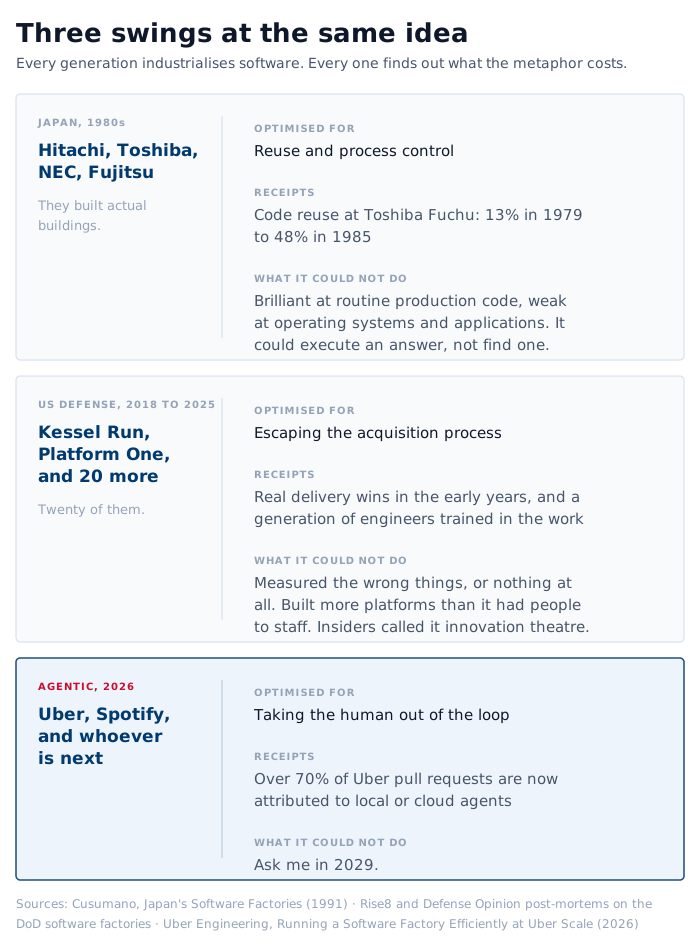
Software factories were tried in 1980s Japan and again across US Defense. Both fell short in the same way. The agentic version in 2026 is different in one specific respect, and it is not the agents.
Read
Most engineering orgs added AI but kept the rituals built for a slower era. Here are eleven things to retire this quarter, and what to replace them with.
Read