The Hidden Cost of Low AI Adoption on Engineering Teams
Teams not using AI tools consistently are not just missing productivity gains. They are accumulating a competitive disadvantage that compounds month by month.
Teams with low AI adoption are not in a neutral position. They are not simply missing a productivity gain they could capture later. They are falling behind on a compounding curve, and the gap between high-adoption and low-adoption teams is not shrinking. It is growing.
This is the aspect of the AI adoption question that most engineering leaders underweight. The conversation is almost always framed as "how much faster could we move with AI tools?" The more accurate framing is "how much of our competitive position in the talent market, the delivery market, and the capability market are we giving up by not building this now?"
The cost of low AI adoption is real, it is measurable, and it compounds. This post makes that case and explains what is actually driving low adoption when it persists past the initial rollout phase.
The Direct Productivity Gap Is Already Measurable
The baseline data for AI coding tools is now well-established. Engineering teams with high AI tool adoption produce significantly more output per engineer than teams without it. The specific numbers vary by tool, team, and codebase, but the directional finding is consistent across every major study in 2025 and 2026: AI-assisted engineers ship more code per unit of time than engineers without AI assistance.
The direct cost of low adoption is therefore straightforward: your team is producing less per engineer than it could be. For a ten-person engineering team where AI tools could improve individual productivity by 20%, the effective output shortfall is two engineer-equivalents of work per sprint. You are doing the work of eight engineers with the cost of ten.
That shortfall is recoverable. If the team adopts AI tools next quarter, the productivity gap closes. The more serious cost is not the direct productivity gap. It is what that gap is being used to create on the other side.
The Compounding Cost: Your Competitors Are Using the Gains
The companies you compete with for customers, for product velocity, and for engineering talent are making AI adoption decisions right now. Some of them are ahead of where your team is. Some are behind. The gap between you and the ones who are ahead is not static.
Every quarter that a competitor's team operates at AI-native productivity while yours operates at AI-assisted or non-AI productivity is a quarter where they are shipping features you are not, responding to market signals faster than you can, and building technical capabilities that will be expensive for you to match later.
This is the compounding dynamic. A competitor that reaches L3 AI maturity six months ahead of you does not just have a six-month head start. They have six months of AI-native delivery compounding. Their codebase is more structured, their team is more capable, their delivery processes are more robust. Closing the gap requires you to match their current state, not their state from six months ago when they were at the same stage as you.
The talent market compounds this further. Engineers with AI-native experience are beginning to select for teams that have AI-native practices in place. A team that has not built these practices is less competitive in the hiring market for the engineers who will compound your advantage most. This is still early, but the direction is clear: in twelve to eighteen months, low AI adoption will be a material talent acquisition disadvantage.
Why Low Adoption Is Almost Never a Tool Problem
When AI adoption is low after a rollout, the default diagnosis is that the tools are not good enough, not well-integrated, or not suited to the team's workflow. This diagnosis is almost always wrong.
The most common causes of persistent low adoption are systemic, not technical.
No coordination. Individual engineers given access to AI tools without a coordinated approach to how those tools should be used will develop widely varying practices. Some will adopt enthusiastically, some will use the tools occasionally, some will barely use them at all. Without shared conventions, the inconsistency persists. Adoption stays bimodal rather than high across the team.
No context infrastructure. Engineers who try AI tools in a codebase without context infrastructure consistently report that the tools produce output that does not fit the codebase. They conclude the tools are not useful and stop using them. The tools are not the problem. The codebase gives the tools nothing to work from, so the output is generic rather than system-specific. This is fixable with a CLAUDE.md, but it is invisible to engineers who do not know the root cause.
No psychological safety. Some engineers, particularly more experienced ones, are reluctant to use AI tools because using them feels like admitting that their skills are being automated. This is understandable and worth addressing directly. The frame that resolves it is leverage rather than replacement: AI tools amplify what experienced engineers know, they do not replace it. The engineers who benefit most from AI tools are the ones with the most domain knowledge, because the tools give them the ability to implement what they know faster.
No management expectation. In many teams, AI tool adoption is positioned as optional. Tools are provided, encouraged, but not expected. In a team where the expectation is not set, adoption levels will reflect individual initiative rather than team practice. The engineers who are naturally early adopters will use the tools. The rest will not, and nobody will ask them to.
The Three Most Common Patterns That Keep Teams at L1
L1 is the awareness stage: engineers know about AI tools, some are experimenting, but there is no coordinated approach and the team as a whole has not changed how it works.
Teams stay at L1 for predictable reasons.
The trial that never became practice. The team ran a trial of Copilot or Cursor, got mixed feedback, and the rollout was declared complete when the trial ended. No one established what "good" looks like for the team. No one set expectations. The tools remain available and largely unused by the majority of the team.
The early adopter problem. One or two engineers became enthusiastic users and demonstrated impressive individual productivity. Leadership pointed to them as proof the tools work. The rest of the team watched without changing their own practice. The productivity gain stayed concentrated rather than distributing. The team's aggregate output improvement was minimal because only a small fraction of the team was actually using the tools.
The failed integration. The team tried to use AI tools for a specific workflow, it did not work well because the codebase lacked context infrastructure, and the conclusion drawn was that the tools are not useful for this team's work. The real conclusion should have been that the context infrastructure needs to be built first. The failed integration became evidence against adoption rather than a diagnostic for what to fix.
How to Close the Adoption Gap Without Mandating Tools
Mandating AI tool use rarely produces genuine adoption. It produces surface compliance and resentment, particularly from experienced engineers who feel their judgment is being automated away. Genuine adoption requires a different approach.
Start with the context infrastructure, not the tool adoption. A CLAUDE.md that makes AI tools produce useful output in your specific codebase is more persuasive than any argument for tool adoption. When engineers see AI tools producing codebase-specific, architecturally consistent output, adoption follows. The tools become useful, and useful tools get used.
Then establish shared practice rather than individual adoption. Pick two or three specific workflows where AI tools provide clear value, standardise those across the team, and make the practice visible. PR description generation, test writing for new code, and documentation generation are common starting points. When the team sees AI tools consistently used in specific, defined ways, the practice normalises faster than when it is left to individual initiative.
Set measurement that shows the team the impact. Teams with visibility into the metrics that matter, incident rate, review cycle time, test coverage trend, adopt AI-native practices faster because they can see the connection between the practice and the outcome. Adoption is easier to sustain when the benefit is visible.
The AI Engineering Maturity Assessment measures adoption consistency as one of its six dimensions and tells you specifically whether your team's adoption pattern is individual or coordinated. If your team is at L1 or stalled in early L2, the assessment gives you a specific starting point for what to address first.
I help engineering teams close the gap between "we use AI tools" and "AI actually changed how we deliver." Book a 20-minute call and I'll tell you where the leverage is.
Thanks for reading.
Notes on AI-native products, platforms and operating models, from twenty years of building technology that pays its way. If this one landed, let's talk.
More writing
All writing →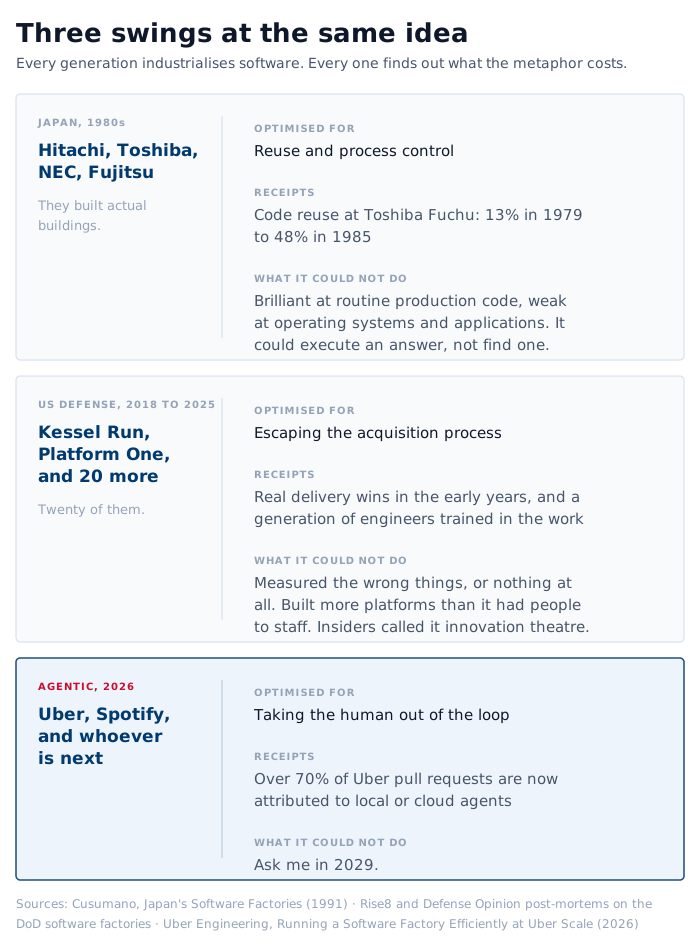
Software factories were tried in 1980s Japan and again across US Defense. Both fell short in the same way. The agentic version in 2026 is different in one specific respect, and it is not the agents.
Read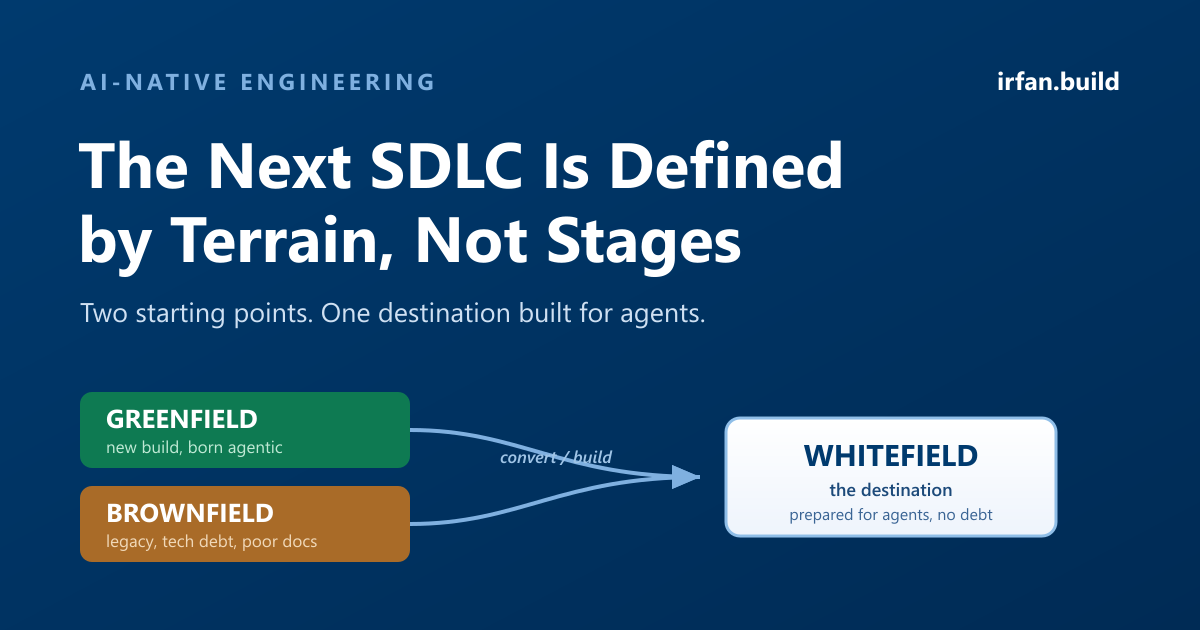
Most engineering teams are running AI on the wrong terrain. The Greenfield, Brownfield, WhiteField framework explains why results disappoint and what to change.
ReadAI-native engineering is not using AI tools. This guide covers what it means, the four capabilities required, and the L1-L4 maturity model that separates real transformation from tool adoption.
Read