Context Engineering Is the Skill That Separates AI-Native Engineers from Everyone Else
Prompt engineering is about what you say. Context engineering is about what you build. It is the emerging discipline that determines whether AI tools produce consistent, accurate output or confident-sounding nonsense.
Prompt engineering became a recognised skill in 2023. By 2025, most engineers working with AI tools had at least a working understanding of how to write prompts that produced better output: be specific, provide examples, describe the format you want, tell the model what to avoid.
Context engineering is something different. It is not about how you phrase a request. It is about the infrastructure you build around AI tools that determines what they know, what they can access, and how they behave before you type a single word.
The practical difference: a well-engineered prompt sent to a poorly configured AI tool produces output that is generically good and specifically wrong. The same prompt sent to a well-configured tool, with the right context infrastructure in place, produces output that is architecturally correct, convention-consistent, and immediately usable. The prompt is the same. The context is different. The output is completely different.
Context engineering is the discipline of building that infrastructure. It is the highest-leverage skill in AI-native engineering, and most engineers have not yet named it, let alone invested in it deliberately.
What Context Is and Why It Determines Output Quality
An AI model's output is determined by two things: what it learned during training and what you give it in the context window. The training is fixed. The context window is what you control.
Context is everything the model can see when it produces a response: your prompt, the conversation history, the files it has been given access to, the instructions in your CLAUDE.md, the Skills that have been activated, the output of tools it has already used in the session. All of it is context. All of it influences the output.
The way most engineers think about context: it is the thing you provide in a prompt. The prompt is the context.
The way context engineers think about it: the prompt is a small fraction of the context. The majority of the context was determined long before the prompt was written, by the infrastructure decisions made when configuring the tool.
This is not a subtle distinction. A developer who writes an excellent prompt in a repository with no CLAUDE.md, no Skills, and no context about the system will get output that reflects the model's best guess about the system based on whatever files it can see locally. A developer who writes a mediocre prompt in a repository with a well-maintained CLAUDE.md, relevant Skills activated, and the right files in scope will get output that reflects an accurate understanding of the system.
The infrastructure matters more than the prompt, by a significant margin.
The Four Layers of Context Infrastructure
Context engineering, applied to AI coding tools, involves four distinct layers. They correspond directly to the four layers of Claude Code's architecture, but the principle applies to any AI coding tool.
System context: The background knowledge about the system that should inform every action the AI takes. In Claude Code, this lives in CLAUDE.md. For other tools, it is the equivalent: workspace rules, system prompts, repository-level configuration. System context is persistent: it applies to every session without needing to be re-specified. It is also the highest-leverage layer to invest in, because it influences every piece of output the tool produces.
A well-built system context describes what the system is, how it is structured, what conventions govern how code is written, what constraints apply, and what the most important things a new contributor should know are. It is not documentation. It is the background a senior engineer carries implicitly when they work in a familiar codebase.
Task context: The knowledge about a specific type of task that should inform how the AI approaches it. In Claude Code, this lives in Skills. Task context is activated selectively: the testing Skill activates when writing tests, the review Skill activates when reviewing code, the deployment Skill activates when running deployment workflows. Each Skill packages the relevant context for a specific task type.
Without task context, the AI approaches each task type with generic knowledge and whatever system context is available. With task context, it approaches each task type with system knowledge plus specialised guidance about how your team does that specific type of work.
Session context: The knowledge accumulated during a specific working session: decisions made, files modified, approaches taken. This is the context that grows as a session progresses and eventually fills the context window. Session context is managed through commit discipline, context compression, and session boundaries.
The key insight about session context: it is temporary and cumulative. Good session context management means starting fresh at natural boundaries, compressing accumulated context when the window fills, and committing frequently so that the next session can start from a clean repository state rather than a context full of accumulated decisions.
Scope context: The specific files, directories, and information made available for a given task. This is about what the AI can see, not what it knows. Scope context determines which files are in scope for search and modification, which are excluded, and which are explicitly highlighted as relevant.
Scope context is often the easiest layer to improve and the most neglected. Removing irrelevant files with .claudeignore, running the tool from the relevant subdirectory rather than the repository root, and explicitly referencing the relevant files in prompts are all scope context decisions that significantly improve output quality.
Context Decay and Why It Matters
One of the more counterintuitive aspects of context engineering is context decay: the degradation of output quality as a session gets longer and earlier context starts to drop out of the window.
Modern AI models have large context windows. Large is not infinite. As a session progresses, earlier exchanges are pushed out to make room for later ones. The model starts to work with a degraded picture of decisions made at the start of the session.
Context decay is the primary cause of what engineers describe as "Claude losing the thread" in long sessions: suggestions that contradict earlier decisions, implementations that do not fit the approach established at the start of the session, a general decline in accuracy relative to the earlier part of the session.
The context engineering response to decay is session structure: explicit plan documents that serve as persistent references throughout the session, frequent commits that externalise decisions from the context window into the repository, and session boundaries at natural task boundaries that prevent accumulated decay from compounding across multiple features.
Engineers who understand context decay build their sessions differently from those who do not. They break work into smaller units. They commit at checkpoints. They use Plan Mode to create a reference document for complex tasks. These practices are not just good habits. They are context engineering responses to a specific, predictable failure mode.
Context Engineering Across the Team
The individual-level skills of context engineering, writing good CLAUDE.md files, building Skills, managing session context, are necessary but not sufficient for team-level impact.
Team-level context engineering requires treating context infrastructure the same way you treat code: version-controlled, reviewed, maintained, and improved over time.
A CLAUDE.md that reflects how the codebase actually works today, not how it worked when someone wrote the file eighteen months ago, is a maintained asset. One that has drifted from reality is a liability: it gives the AI incorrect information, which produces output that is confident and wrong. Maintaining the accuracy of context infrastructure requires assigning ownership, building update review into the team's development process, and treating a CLAUDE.md that has fallen out of date as a bug rather than an acceptable condition.
Skills libraries are team assets. The knowledge encoded in a well-built Skills library, how your team writes tests, how it structures code reviews, what conventions govern commit messages, represents accumulated institutional knowledge in a machine-readable form. That knowledge is worth investing in, maintaining, and protecting the same way you would protect any other institutional asset.
The teams that have made this investment describe the same experience: new engineers become productive faster because the context infrastructure gives them accurate information about how the team works from day one. Experienced engineers spend less time on correction because the AI's output fits the system's conventions from the first attempt. The accumulated investment in context infrastructure pays back continuously.
The Mental Model Shift
The most useful way to think about context engineering is as infrastructure work, not configuration work.
Configuration is something you do once and forget. Infrastructure is something you build, maintain, and improve over time because it is load-bearing.
The CLAUDE.md in your repository is load-bearing. Every piece of output Claude produces in that repository is influenced by it. If it is wrong, every piece of output is wrong in a consistent, hard-to-detect way. If it is accurate, every piece of output benefits from accurate context. Treating it as infrastructure, with the maintenance discipline that implies, is the right frame.
The same is true of Skills, of session structure, of scope management. These are not one-time setups. They are ongoing maintenance tasks with ongoing returns.
Engineers who have developed this frame consistently outperform those who have not, not because they are better at prompting, but because the infrastructure they work in produces better context for every session, every task, every piece of output. The compounding effect over months is significant.
Prompt engineering is a skill. Context engineering is the skill that determines what prompt engineering can accomplish.
I help engineering teams close the gap between "we use AI tools" and "AI actually changed how we deliver." Book a 20-minute call and I'll tell you where the leverage is.
Thanks for reading.
Notes on AI-native products, platforms and operating models, from twenty years of building technology that pays its way. If this one landed, let's talk.
More writing
All writing →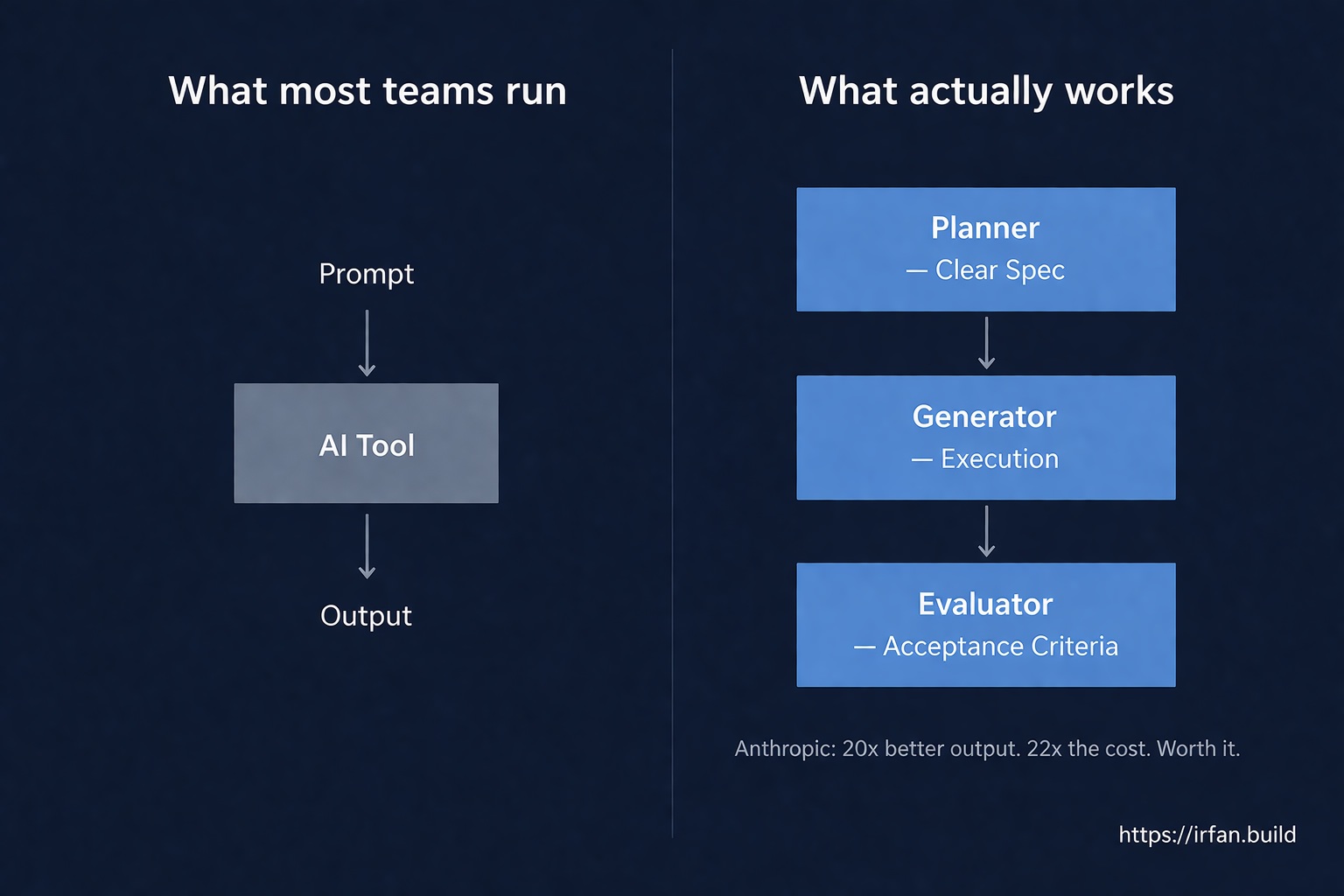
Anthropic's engineering team published a technical deep-dive on multi-agent harness design. What they actually published was an org chart, and it explains exactly why most AI initiatives produce underwhelming results.
ReadAI tools increased PR volume by 98% on some teams. Code review processes designed for human-paced output cannot handle that. The bottleneck is now review, not production, and the fix is not reviewing faster.
ReadEntry-level engineering roles have dropped significantly since AI tool adoption accelerated. Most engineering leaders are not paying attention to this. They should be.
Read