AI-Native vs AI-Assisted: How to Tell the Difference
Three diagnostic tests that reveal whether your engineering team is truly AI-native or just AI-assisted, and why the difference determines what you should do next.
Most teams that describe themselves as AI-native are AI-assisted. The distinction matters not because of the label but because the two positions require completely different interventions. An AI-assisted team needs to build systems. An AI-native team needs to optimise them. Applying the wrong intervention wastes months and produces disappointment that teams often wrongly attribute to the limits of AI itself.
This post gives you three diagnostic tests that tell you which one your team actually is, without requiring a formal assessment or a consultant.
Why Teams Consistently Misdiagnose Themselves
The confusion is understandable. The external signals of AI-assisted and AI-native look similar from a distance. Both teams use AI tools. Both report productivity improvements. Both have engineers who describe their work as AI-first.
The difference is in the system, not the individuals. An AI-assisted team has productive individual engineers working in a system that has not changed. An AI-native team has restructured the system itself so that AI operates effectively at every stage: in the codebase, in the review process, in the delivery pipeline, in the measurement of outcomes.
You cannot diagnose this from tool adoption metrics. A team can have 100% Copilot usage and be deeply AI-assisted if the codebase has no context infrastructure, the test suite gives agents nothing meaningful to work from, and quality measurement is still velocity-focused. Conversely, a team with partial tool adoption but strong context infrastructure and quality measurement may be further along the AI-native path than a team with full adoption and none of the foundations.
Tool adoption is a necessary but not sufficient condition for AI-native engineering. The three tests below cut through the tool adoption signal and get to the system signal underneath it.
Test One: What Happens When a Senior Engineer Is Unavailable
This is the most revealing test. Remove your most senior engineer from the picture for a sprint. Not literally, but ask the question: if they were unavailable for two weeks, what would actually happen?
If the team would slow significantly, if architectural decisions would stall, if there are specific parts of the codebase that other engineers would approach with low confidence or avoid entirely, your capability lives in a person rather than in a system. That is an AI-assisted team. Individual engineers, especially senior ones, are the carriers of context and judgment. AI tools amplify them, but they do not distribute the capability to the rest of the system.
In an AI-native team, the system carries much of what the senior engineer carries. The CLAUDE.md and architecture decision records capture the context and the reasoning behind key decisions. The review standards capture what good code looks like in this codebase specifically. The test infrastructure captures the expectations that must be met. A less experienced engineer, or an agent, can work in the codebase and get meaningful feedback about whether their work meets the standard, without requiring a senior engineer to hold their hand through it.
This does not mean senior engineers become unnecessary. It means their leverage multiplies rather than becoming a bottleneck. They are free to work on the problems that actually need their judgment rather than constantly being the single carrier of context for every domain they have ever touched.
If removing a senior engineer from the picture would create a real, visible problem, your team is AI-assisted regardless of what the tool adoption numbers show. The next question is what specifically that senior engineer is carrying that the system is not.
Test Two: What Is Your Incident Rate Doing Compared to Your PR Rate
The second test is quantitative. Pull the last 90 days of data on two metrics: pull requests merged per week and incidents per week. Plot them on the same chart. What you are looking for is whether the relationship between these two metrics has changed since AI tool adoption began.
In an AI-assisted team, you will typically see PR rate go up and incident rate either stay flat or rise. This is the pattern documented in the 2026 State of AI Benchmark from Cortex.io: 20% more pull requests per engineer, 23.5% more incidents per pull request. More output entering a system that was not redesigned to handle more output produces more incidents. The math is straightforward once you see it.
In an AI-native team, you will see PR rate go up and incident rate either stay flat or decline. The system has been redesigned to absorb higher output: better test coverage that catches what faster production creates, tighter review standards that maintain quality at volume, quality gates in the pipeline that do not scale linearly with human attention. More output does not mean more incidents because the containment mechanisms have been built alongside the output acceleration.
There is a secondary diagnostic inside this test: if your incident rate has gone up but the team attributes it to growth, complexity, or bad luck rather than to AI adoption, that attribution pattern itself is diagnostic. AI-assisted teams tend to separate the velocity gain from the quality cost because the gain is visible and celebrated while the cost is diffuse and delayed. AI-native teams track both because they have the measurement infrastructure to see both.
If you do not have this data, that is itself diagnostic. A team without quality measurement is, by definition, not AI-native. Quality measurement is one of the four capabilities that define AI-native engineering, and the one most consistently absent from teams that believe they have completed their AI transformation.
Test Three: What Does Your Codebase Tell AI Tools
The third test is an experiment. Open an AI coding tool: Cursor, Claude, Copilot, or equivalent. Give it a non-trivial task in a part of your codebase that is not the core domain you work in most days. Somewhere less familiar, with less recent activity. Observe what the output looks like.
Specifically: does the output respect the architectural patterns of the wider codebase? Does it follow the naming conventions, the testing approach, the documented constraints, the patterns you use for error handling and logging and state management? Or does it produce technically correct code that is architecturally inconsistent with what surrounds it?
An AI-native codebase has context infrastructure that tells AI tools what the system is and how it is built. The output of AI tools reflects this context because the tools are working from real information, not local inference. An AI-assisted codebase gives AI tools nothing to work from beyond the code itself in the immediate vicinity. The output reflects local patterns, which may be representative of the core but often drifts significantly in less well-maintained areas.
You can feel this in practice without running a formal experiment. When engineers or AI tools work in less-familiar parts of the codebase, do they produce work that fits the system naturally, or work that needs significant rework to be made consistent with the surrounding code? If the answer is the latter, your codebase lacks context infrastructure. That is an AI-assisted team operating without the foundation that would make it AI-native.
The specific form of context infrastructure that matters most is a CLAUDE.md or equivalent file: a document in the root of the repository that describes the system, the key architectural decisions, and the conventions that govern how code is written. The post on CLAUDE.md covers what to put in this file and how to maintain it. It is the single highest-leverage infrastructure change a team can make to move from AI-assisted to AI-native.
What Each Diagnosis Means for What to Do Next
Most teams, when they run these three tests, discover they are AI-assisted. That is not a failure or a reflection on how far behind the team is. It is accurate information, and accurate information is the starting point for effective action.
If Test One reveals that capability lives in people rather than in the system, the next move is context infrastructure: CLAUDE.md, architecture decision records, written review standards. These distribute the judgment the senior engineer holds into the system itself.
If Test Two reveals that incidents are rising alongside PR rate, the next move is quality measurement and test infrastructure. You need visibility into the system-level health before you can improve it, and you need a test suite that gives agents and engineers meaningful feedback when they introduce changes.
If Test Three reveals that the codebase does not tell AI tools what the system is, the next move is the same as Test One: context infrastructure first.
The sequence matters. Teams that try to implement full agentic workflows before building context infrastructure find that the agents produce technically functional but architecturally inconsistent output. Teams that implement quality measurement before they have test infrastructure to act on find that the metrics reveal problems they have no systematic way to address. Building in order produces compound returns. Building out of order produces rework.
The AI-Native Engineering Guide covers the four capabilities in full and the sequence for building them. The AI Engineering Maturity Assessment scores your team across six dimensions and produces a specific roadmap, so you know not just where you are but what to build first.
The tests in this post are the fast version of that diagnosis. They will not give you the same precision, but they will tell you with reasonable confidence whether you need to build systems or optimise them.
I help engineering teams close the gap between "we use AI tools" and "AI actually changed how we deliver." Book a 20-minute call and I'll tell you where the leverage is.
Thanks for reading.
Notes on AI-native products, platforms and operating models, from twenty years of building technology that pays its way. If this one landed, let's talk.
More writing
All writing →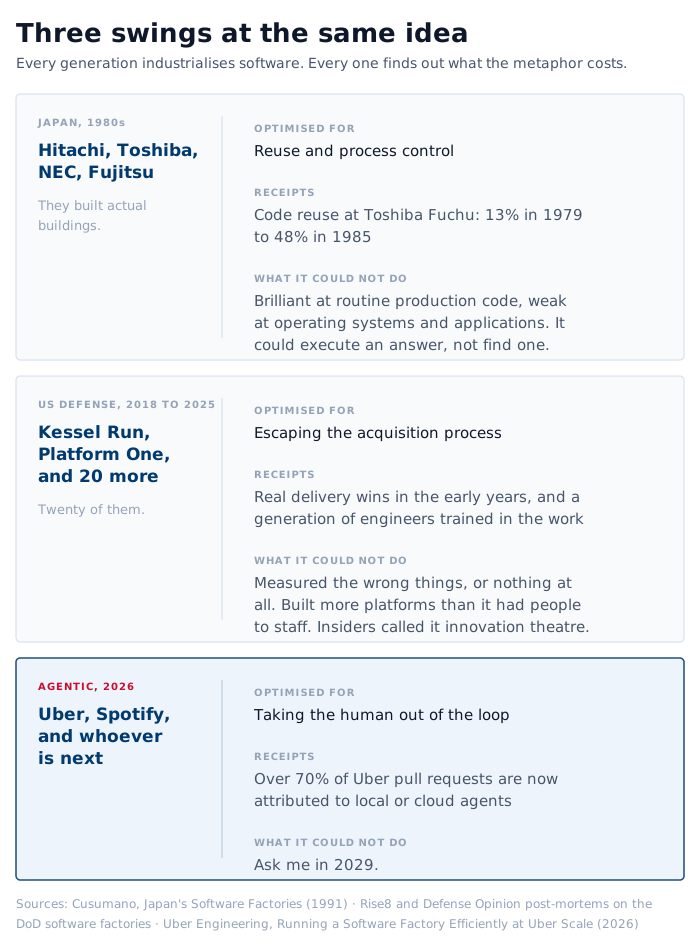
Software factories were tried in 1980s Japan and again across US Defense. Both fell short in the same way. The agentic version in 2026 is different in one specific respect, and it is not the agents.
Read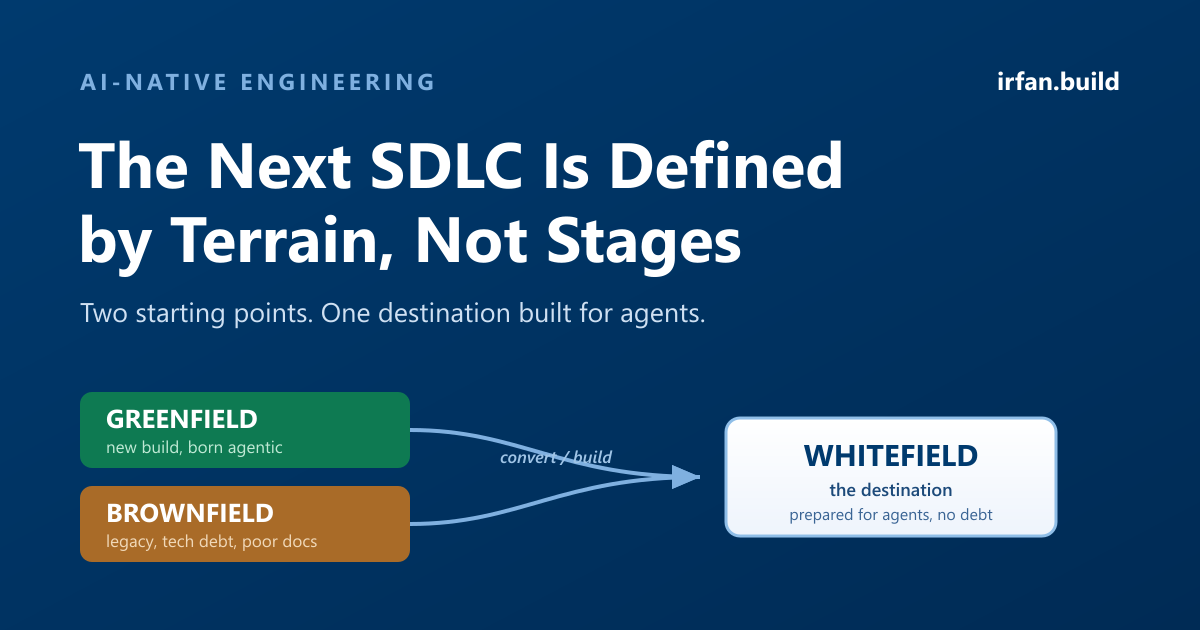
Most engineering teams are running AI on the wrong terrain. The Greenfield, Brownfield, WhiteField framework explains why results disappoint and what to change.
ReadAI-native engineering is not using AI tools. This guide covers what it means, the four capabilities required, and the L1-L4 maturity model that separates real transformation from tool adoption.
Read