AI-Native Engineering: The Complete Guide
AI-native engineering is not using AI tools. This guide covers what it means, the four capabilities required, and the L1-L4 maturity model that separates real transformation from tool adoption.
AI-native engineering is not about which AI tools your team has access to. It is about how your entire engineering system is structured to work with AI: your codebase, your processes, your team's capabilities, and the feedback loops that connect them. Most teams that call themselves AI-native have adopted AI tools. That is not the same thing, and the gap between the two is where most transformation efforts fail.
This guide explains what AI-native engineering actually means, the four capabilities it requires, and the maturity model that tells you exactly where any engineering team currently sits.
AI-Native and AI-Assisted Are Not the Same Thing
The distinction matters because the outcomes are completely different.
An AI-assisted team has given engineers access to AI tools. Engineers use Copilot to autocomplete code, ask ChatGPT to debug a function, use Cursor for refactors. The productivity gains are real at the individual level. But the system they work in has not changed. The codebase is structured the same way. The review process is the same. The deployment pipeline is the same. Incidents happen at the same rate, or faster, because more code is entering a system that was not designed to handle more code.
An AI-native team has restructured its engineering system so that AI operates effectively at every stage. The codebase has context infrastructure that tells AI tools what the system is, how it is organised, and what the conventions are. The test suite provides feedback that agents can act on. The review process has adapted to handle AI-generated output at volume. The deployment pipeline has quality gates that catch what faster production creates.
The data reflects this distinction clearly. Engineering teams using AI coding tools in 2026 produce 20% more pull requests per engineer, but incidents per pull request are up 23.5%. That is the AI-assisted outcome: more output, more fragility. An AI-native team avoids that pattern because the system is designed to absorb higher output without proportionally higher failure rates.
The difference is not which tools you use. It is whether your engineering system has been redesigned to work with AI, or whether AI tools have been placed on top of a system built for humans writing code at human speed.
The Four Capabilities That Define AI-Native Engineering
AI-native engineering requires four capabilities working in combination. Most teams have one or two. Almost none have all four established before declaring themselves AI-native.
Context infrastructure. AI tools are only as useful as the context they can access. A codebase with no architecture documentation, no documented conventions, and no persistent explanation of key decisions forces AI to guess. It guesses based on what it can see locally, without understanding why the system is structured the way it is. Context infrastructure means having a CLAUDE.md or equivalent file in the root of the repository that describes the system to any AI tool reading it: what it does, how it is organised, what the key architectural decisions are and why they were made, and what the conventions are for naming, testing, and documentation. This is not optional documentation. It is the foundation that makes everything else work. Without it, AI tools operate on incomplete information and produce output that is technically correct in isolation and architecturally inconsistent at scale.
Agent-ready test infrastructure. AI agents need a test suite they can run and interpret. Not a test suite that exists, but one that provides meaningful feedback at the right granularity. When an agent makes a change and tests fail, it needs to know specifically what broke and why. Tests that produce vague failure messages, or that fail at too high a level to isolate the cause, are not agent-ready. Coverage needs to be concentrated where agents are most likely to introduce risk: boundary conditions, integration points, shared state. Most codebases have a test suite written by humans for humans. Agents need different signals. Rebuilding test infrastructure for agent use is one of the most consistently underestimated parts of the AI-native transition.
AI-adapted review processes. When engineers produce more code faster, the review process is the first constraint that breaks. In an AI-native team, code review has adapted: senior engineers review patterns and architecture rather than line-by-line syntax. Review standards are explicit and written down rather than held in senior engineers' heads. Automated review at the PR level catches what humans should not have to catch manually. The goal is a review process that scales with output rather than becoming the bottleneck when output doubles. Teams that do not adapt their review process often discover the cost later: increased incident rates and senior engineer burnout from review volume rather than engineering work.
Quality measurement that reflects system health. An AI-native team does not measure velocity and call it productivity. It measures the health of the entire system: incident rate, change failure rate, mean time to recovery, review cycle time, test coverage trends. These are the signals that tell you whether AI is improving the system or just making it faster to degrade. Teams without quality measurement cannot distinguish between genuine improvement and a liability transfer that will show up as incidents three months later. In my experience working with engineering teams, this is the capability most consistently missing, and the one that makes the other three difficult to evaluate honestly.
The L1 to L4 AI Maturity Model
I use a four-level maturity model to assess where any engineering team sits on the AI-native journey. The levels describe how deeply AI is embedded into the engineering system, not how enthusiastically the team has adopted AI tools. How far the climb runs depends partly on the terrain your codebase starts from; the model measures the climb, not the ground.
L1: Ad-hoc AI Use. The team understands what AI-native engineering means and some engineers are experimenting with tools. There is no coordinated approach. Adoption varies significantly between individuals. The codebase, processes, and review practices have not changed. Some individuals are more productive. The system is not.
L2: Assisted Development. AI tools are part of the daily workflow for most of the team. Copilot or equivalent is in consistent use. Some processes have adapted: PR descriptions are being generated with AI assistance, simple test generation is happening, some documentation is being produced with AI support. But the codebase still has no context infrastructure. Review processes have not adapted to the increased output. Quality metrics are still velocity-focused. This is where most teams plateau and declare success, because the productivity gains at this level are real and visible in the numbers leadership is already tracking.
L3: AI-Native. AI is embedded into the engineering system, not just the engineers' individual workflow. Context infrastructure is in place. The test suite is agent-ready. Review processes have adapted to handle higher output volumes without degrading quality. Quality is measured at the system level, not just at the velocity level. Engineers are using AI to make architectural decisions, generate and maintain tests, and run automated review. The system produces AI-assisted output at higher volume without a proportional increase in incident rate. This is where many teams aim next when they talk about real AI transformation.
L4: Agentic Development. This is the destination. Full agentic workflows. Agents operate on well-scoped tasks end-to-end within clearly defined boundaries, with human review at specific escalation points. The engineering team designs and maintains intelligent systems rather than writing all code manually. Continuous optimisation is partially automated: the system generates feedback about its own performance and agents act on that feedback within defined parameters. This level requires L3 to be fully established first. Teams that attempt L4 without L3 foundations fail consistently because the agents have no reliable context to work from and no test infrastructure to validate against.
The AI Engineering Maturity Assessment scores your team across five specific dimensions and tells you exactly where you sit on this model. It takes five minutes and the results are specific to your team, not generic.
Most Teams Stall at L2 Because They Confuse Tool Adoption With Systems Change
L2 looks like success. Velocity is up. Engineers are energised. The tools are clearly working. This is often where leadership announces that the AI transformation has been completed.
What has not happened: the engineering system has not changed. The codebase is structured the same way it was before AI tools arrived. The review process is the same. Quality measurement is still velocity-focused. The team has adopted AI tools into a system designed for humans writing code at human speed. When AI tools produce more code faster than that system can handle, the cracks appear.
The pattern I have seen across engineering teams follows a predictable sequence. Velocity metrics improve and get reported upward. Everyone feels the momentum. Then, quietly, the incident rate starts climbing. Review burden increases as more PRs enter the queue. Senior engineers spend more time on review and less time on engineering. The team attributes this to complexity or growth rather than to AI amplifying the weaknesses that were already there.
The 2026 State of AI Benchmark from Cortex.io captures this in aggregate: incidents per PR up 23.5%, change failure rates up 30%. Individual teams experience it as a creeping instability that is hard to trace back to AI adoption because the adoption happened months before the symptoms appeared.
Moving from L2 to L3 is not an incremental improvement. It requires deliberately changing the engineering system. That transition feels like slowing down, which is why most teams resist it. The foundation work is genuinely costly in the short term. The alternative is compounding a fragile system until a sufficiently painful incident makes the cost undeniable.
What the Move to L3 Actually Requires
The move from L2 to L3 is a systems change, not a tool change. It requires building four specific things, in roughly this order.
Start with context infrastructure. A CLAUDE.md or equivalent in the root of the repository is the entry point. This file does not have to be comprehensive on day one. It needs to be accurate: what does the system do, how is it organised, what are the key constraints and conventions. The goal is to give any AI tool reading it enough grounding to make appropriate decisions rather than guessing. Update it whenever a significant architectural decision is made. Treat it as a living document that AI tools and new engineers both rely on. Teams that build this first consistently find that every other piece of the L3 transition becomes easier because the tools they are using have something real to work from.
Rebuild the test suite for agent use. This does not mean rewriting every test. It means auditing the existing suite for the signals it gives back. Do tests fail at a granularity that tells an agent specifically what broke? Do error messages point to the cause or just the symptom? Is coverage concentrated in the places where agents are most likely to introduce risk? For most codebases this is an audit and targeted rebuild over four to eight weeks, not a ground-up rewrite. The output is a test suite that gives actionable feedback rather than just a pass/fail signal.
Write down your review standards. Capture what senior engineers know implicitly: what a good PR looks like, what architectural decisions require escalation, what categories of change require what depth of review. These standards have always existed; they have lived in senior engineers' heads. When AI agents and engineers both moving faster are making more changes, implicit standards are not enough. Making them explicit is a one-time investment that compounds: every engineer and every agent benefits from it, and it onboards new team members faster as a side effect.
Add quality metrics alongside velocity. Start tracking incident rate, change failure rate, and review cycle time. The goal is not to penalise speed. It is to know whether the speed is creating value or creating risk. You cannot manage what you are not measuring, and you cannot tell whether your L3 transition is working unless you have the baseline data to compare against.
How to Assess Where Your Team Actually Sits
The most telling signal is what happens when a senior engineer is unavailable. If the team slows significantly, stalls on architectural decisions, or pushes changes without confidence, the team has not yet built AI-native capability. It has AI-assisted individuals. The capability sits in people, not in the system.
The second signal is incident rate trend. If velocity has increased over the past quarter and incidents per release are flat or rising, the team is in L2 and probably does not know it. The productivity gain is real. The system degradation is real. Only one is being tracked.
The third signal is what happens at the edges of the codebase. When agents or engineers work in areas that are less well-documented, less well-tested, or further from the core, do they produce reliable output or does quality visibly drop? AI-native systems have consistent quality across the codebase because context infrastructure and review standards apply everywhere. AI-assisted teams have high quality at the core and degrading quality at the edges, because that is where human knowledge was always thinnest and AI has no substitute for it.
The AI Engineering Maturity Assessment measures six dimensions: context infrastructure, tool adoption consistency, quality and verification, delivery integration, quality measurement, and agentic operations and governance. It identifies exactly where the gaps are, not just the overall level, and produces a specific roadmap for what to build next. If your team is stalled at L2, it tells you which L3 foundations are missing and in what order to address them.
AI-native engineering is achievable for any team willing to build the system rather than just adopt the tools. The distinction between the two is everything, and the teams that make the transition are not the ones with the best tools. They are the ones with the most deliberately constructed foundations.
I help engineering teams close the gap between "we use AI tools" and "AI actually changed how we deliver." Book a 20-minute call and I'll tell you where the leverage is.
Thanks for reading.
Notes on AI-native products, platforms and operating models, from twenty years of building technology that pays its way. If this one landed, let's talk.
More writing
All writing →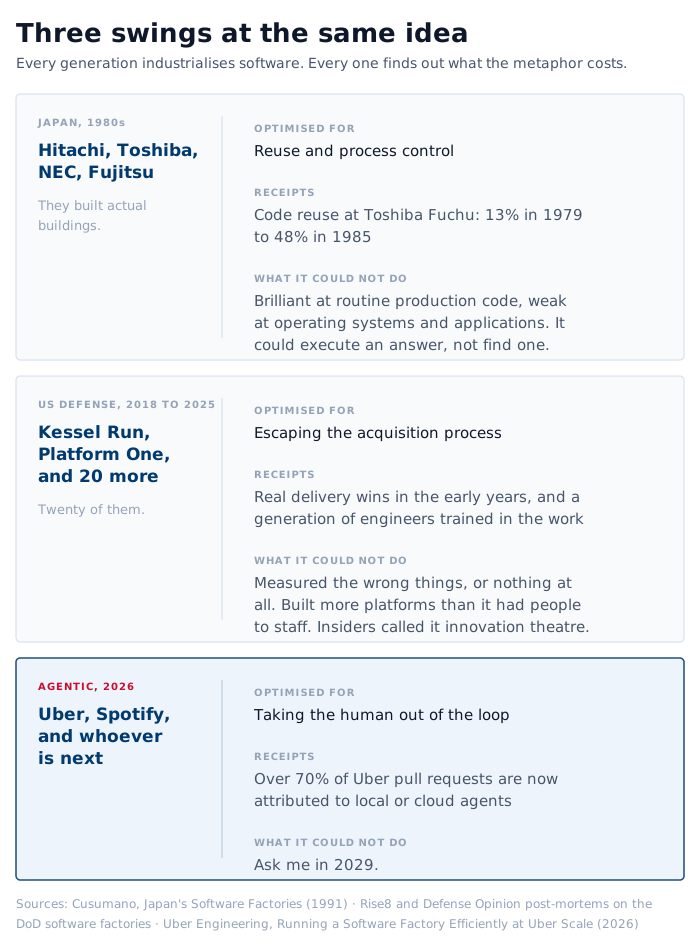
Software factories were tried in 1980s Japan and again across US Defense. Both fell short in the same way. The agentic version in 2026 is different in one specific respect, and it is not the agents.
Read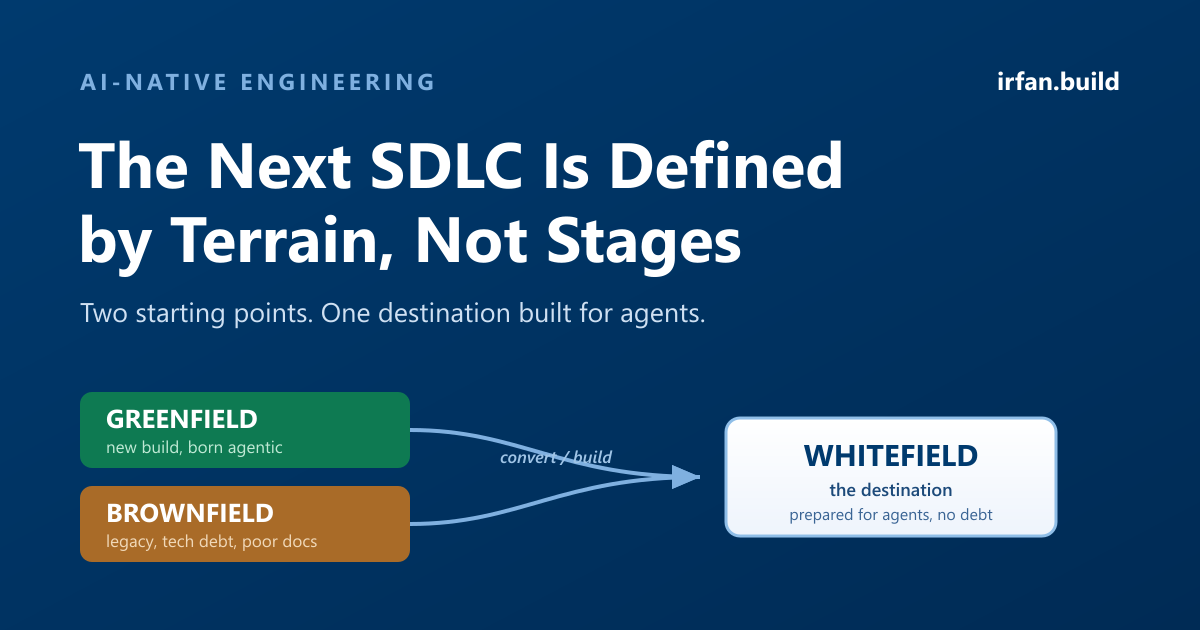
Most engineering teams are running AI on the wrong terrain. The Greenfield, Brownfield, WhiteField framework explains why results disappoint and what to change.
ReadTeams not using AI tools consistently are not just missing productivity gains. They are accumulating a competitive disadvantage that compounds month by month.
Read