AI Makes Vague Requirements Expensive
AI requirements planning doesn't fix vague specs, it accelerates them. Teams now build the wrong thing faster, with more confidence, at a higher cost to undo.
AI doesn't fix your planning problems. It funds them. The speed advantage AI adds to execution means teams now build the wrong thing faster, with more confidence, and at a cost to undo that is substantially higher than before.
The teams getting real ROI from AI are not the ones who moved fastest. They are the ones who got serious about AI requirements planning before they adopted the tools. They tightened their tickets, sharpened their acceptance criteria, and forced explicit decisions at the front of the delivery process. Then they let AI accelerate the back end.
If your team skipped that step, you didn't avoid the cost. You deferred it, and AI made sure it arrived with interest.
AI Didn't Create Your Planning Problem. It Made It Expensive.
Every engineering team has always had a requirements problem. Vague specs, implicit assumptions, acceptance criteria written after the fact, feature descriptions that leave half the edge cases to interpretation. This is not new. It predates agile, it predates scrum, and it has survived every process initiative most teams have ever run.
Before AI, the consequences were manageable: a feature built wrong took two weeks to build, and rework took another two. Painful, but bounded. The cost of imprecision was roughly proportional to the speed of execution. Slow execution, bounded cost.
AI collapsed the build time. A feature that used to take two weeks now takes two days. What didn't change is the rework cost. In many cases it grew, because the wrong thing is now built to a higher standard of polish, integrated deeper into the codebase, and delivered faster to stakeholders who now have opinions about it. The cost of imprecision is no longer proportional to the speed of execution. It's proportional to the speed of execution, plus the drag of convincing people to abandon something that already looks finished.
The Cortex.io 2026 Engineering Benchmark makes this concrete. AI-generated pull requests have a 32.7% acceptance rate, compared to 84.4% for human-authored PRs. That is not a tool failure. That is a signal that nearly two-thirds of what AI produces is built on an insufficient input. The problem is upstream of the model. It is in what engineers are handing the model to work with.
Vague input has always produced wrong output. AI didn't invent that relationship. It just made the wrong output arrive faster, look more finished, and cost more to reverse.
There is also a confidence problem that rarely gets named directly. When engineers move fast with AI, they tend to feel productive. When stakeholders see output arrive quickly, they read it as competence. Both things can be true while the team is building the wrong thing at speed. The metric that catches it, rework rate, cycle time on fixes, stakeholder rollback requests, is almost never tracked alongside velocity. Which means teams often don't know they are in this pattern until they are well inside it.
Fast Execution Raises the Cost of Getting It Wrong
There is a logic to "move fast and iterate" that made sense in a world where execution speed was the constraint. When three sprints to build something was the norm, the cost of building the wrong thing was three sprints. Not pleasant, but calibrated to the pace of work. Iterate and course-correct.
When it takes three days, the math feels different: if you're wrong, you've only lost three days. That logic breaks down in several places, and it breaks down faster than most leaders expect.
The first is rework scope. AI-generated code tends to be complete, not skeletal. It connects to APIs, handles edge cases, generates tests, and produces documentation. It is not a rough prototype you can throw away. When stakeholders see it, they treat it as a working product, because it is. Undoing it is not a matter of deleting a skeleton. It requires understanding everything the code assumes, identifying what it touches, and rebuilding from a corrected spec. That work does not compress with AI the way the initial build does.
The second is stakeholder anchoring. The faster you ship a wrong feature, the faster people form opinions around it. I've run enough delivery reviews to recognise the pattern: a working demo, even one built to the wrong requirements, creates gravity. The conversation stops being "what should we build" and becomes "what should we change about this." That is a fundamentally harder conversation to reset, and resetting it takes real capital, both relational and calendar.
The third is confidence. AI-generated code carries a surface credibility that handwritten code doesn't always earn. It is clean, internally consistent, and structured like someone who thought it through. Senior engineers are more likely to approve it without questioning whether the underlying requirement was right. Sixty-six percent of engineers name "AI solutions that are almost right but not quite" as their top frustration. Almost right, built fast, and merged without scrutiny: that is the most expensive failure mode in software delivery right now. And it is almost entirely a requirements problem, not a model problem.
What Good Requirements Look Like When AI Is Doing the Building
The bar for a well-formed requirement has always been higher than most teams held. With AI in the loop, that bar is non-negotiable. The model will fill gaps in your spec. It will not fill them the way you intended. It will fill them in whatever way is most plausible given the context you provided, and it will do so without flagging that a gap existed.
I've watched teams hand a model a two-sentence feature description and receive back a complete implementation that was technically excellent and completely wrong. Not wrong in a way the model could have caught. Wrong because a decision that lived in a product manager's head never made it into the ticket. The model had no way to know. It made the most reasonable call it could with what it had.
The teams I've worked with that are getting consistent output from AI share four practices at the requirements level.
Clear outcomes, not just features. The ticket describes the user problem and the measurable signal that the problem is solved, not just the capability to be built. "Allow users to save drafts" is a feature. "Reduce form abandonment on checkout step two by enabling draft saves, measurable by comparing abandonment rate before and after deployment" is an outcome. AI can implement both. Only one of them gives you a basis for evaluating whether what was built was actually right.
Explicit non-goals. What this ticket will not do is as important as what it will do. Without a stated scope boundary, AI will make reasonable-sounding extensions that sit outside intent. I've seen generated code add email notifications, background processing, and admin views to a ticket that asked for a simple state save. Each addition was defensible in isolation. None were requested. Non-goals force the person writing the spec to think about scope, and they constrain the model's interpretation space.
Defined boundary cases. What happens when the user is not logged in? When the session expires mid-flow? When the input is malformed or the upstream service returns a timeout? If these are not in the spec, the model handles them with default behavior, which may or may not match product intent. Most support tickets trace back to a boundary case someone decided was not worth speccing. That decision is more expensive now, because the default handling arrives faster and is harder to locate in a larger, AI-generated codebase.
Stated assumptions. What is the spec taking for granted? What upstream dependency does it rely on? What is the assumed state of the system when this feature runs? Assumptions that live in someone's head are not in the context window. They do not exist for the model. The teams getting the most consistent output from AI have a shared habit of writing down what they know, not just what they want. That habit is the difference between a model that builds what you meant and one that builds what you said.
None of this is new thinking on requirements. It is what good product engineering has always demanded. What changed is the penalty for skipping it.
The Investment That Compounds With Every AI Tool You Adopt
There is a version of this conversation that frames requirements quality as a one-time intervention: clean up the spec process, run some sessions, establish a template, move on. That framing is wrong, and it leads teams to underinvest in a place where the return is highest.
Requirements quality is a compounding asset when AI is in the loop. Every improvement to your front-end process multiplies across every ticket handed to a model, every sprint, every engineer, every tool added to the stack. A tighter ticket is not just one better interaction with an AI coding tool. It is a better outcome in every one of the hundreds of interactions that ticket's requirements touch across the delivery lifecycle. The investment scales.
The reverse is equally true. Every shortcut at the requirements stage multiplies as well. Teams that add more AI capability without improving their planning process do not dilute the problem. They amplify it across more velocity and more surface area. More output, more rework, more stakeholder alignment cost, more technical weight anchored around the wrong implementation.
I've seen this play out directly. Teams that rolled out AI tooling aggressively, saw productivity metrics spike in the first quarter, and then spent the following two quarters in a repair cycle that erased the gains. The problem was not the tools. The tools worked as intended. The problem was that the tools amplified a requirements process that had always been the weakest link in the delivery chain and had never been fixed because the symptoms arrived slowly enough to blame on other causes.
AI removed the slow arrival. The symptoms came at sprint speed, and at scale.
The teams that avoided this made a different investment first. Not a comprehensive process overhaul. Not a requirements management platform. A specific set of questions that had to be answered before any ticket moved to implementation: What outcome does this serve? What is out of scope? What are the edge cases we have already resolved? What assumptions are we making explicit? Thirty minutes of discipline per ticket, applied consistently, before the model sees a single line of context.
That discipline did not slow them down. It is precisely what made the speed sustainable. The teams shipping features in days that used to take weeks are not doing it by skipping the front end. They are doing it by compressing everything else, and they can only do that because the front end is tight enough to support it.
If your team is deciding where to invest to get more from AI, the answer is almost never more tooling, better models, or extended onboarding. It is the process that happens before the model is given anything to work with. That process is either a compounding asset or a compounding liability. There is no neutral position. Every sprint, it compounds in one direction or the other.
You can get a structured view of where your team sits across this dimension and several others at assessment.irfan.build. The teams I've seen use it well run the assessment before they make their next tooling investment, not after they've spent a quarter discovering what the gaps cost them.
I help engineering teams close the gap between "we use AI tools" and "AI actually changed how we deliver." Book a 20-minute call and I'll tell you where the leverage is.
Thanks for reading.
Notes on AI-native products, platforms and operating models, from twenty years of building technology that pays its way. If this one landed, let's talk.
More writing
All writing →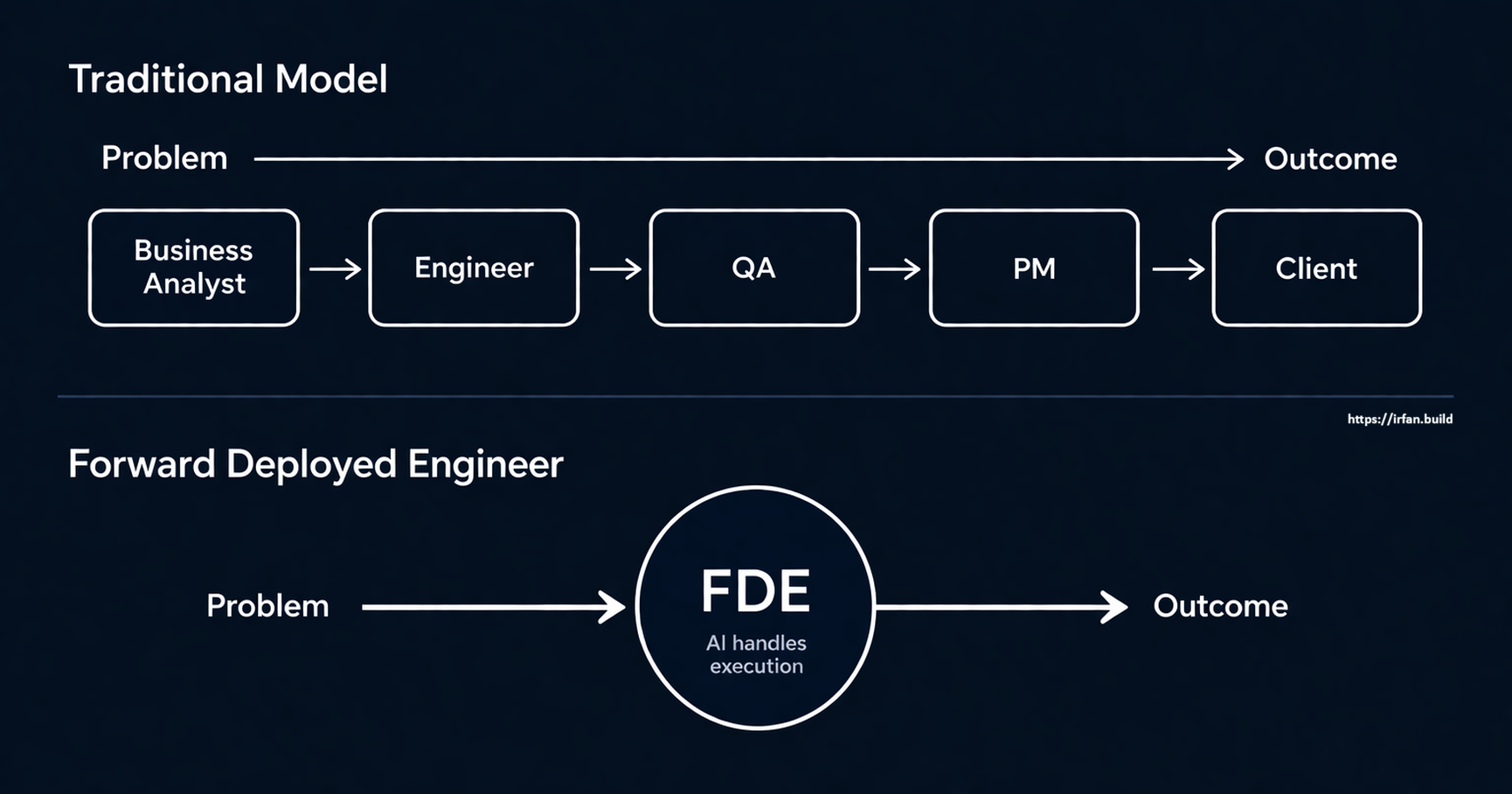
Palantir built a role in 2015 that most companies had never heard of. One engineer, full ownership, deployed directly into the client's problem. AI didn't create the role. It made it possible at scale.
Read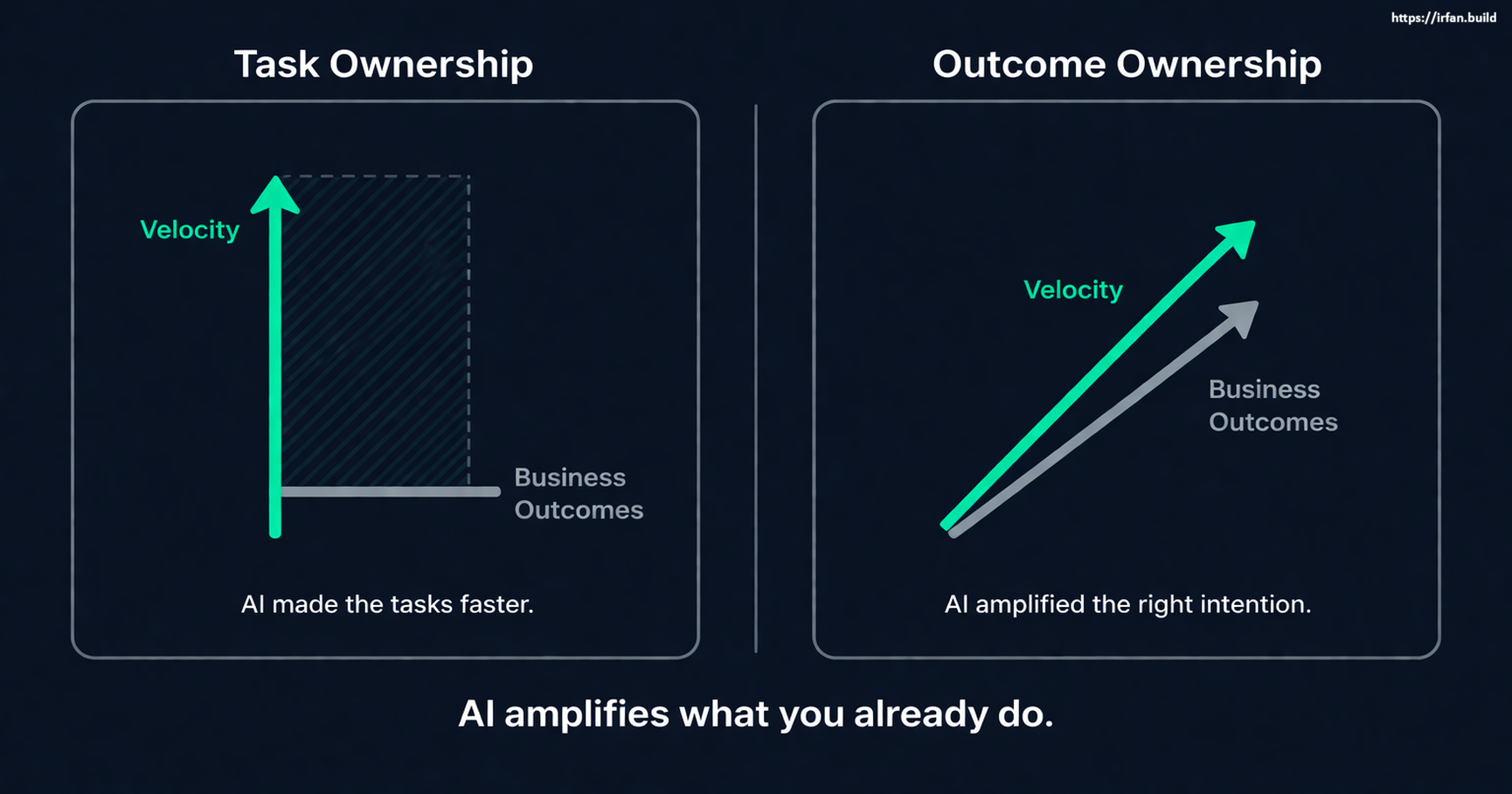
Teams frustrated with AI ROI share a common pattern. The tools are working. The work is getting done faster. The business outcomes have not changed. That is not a tools problem.
Read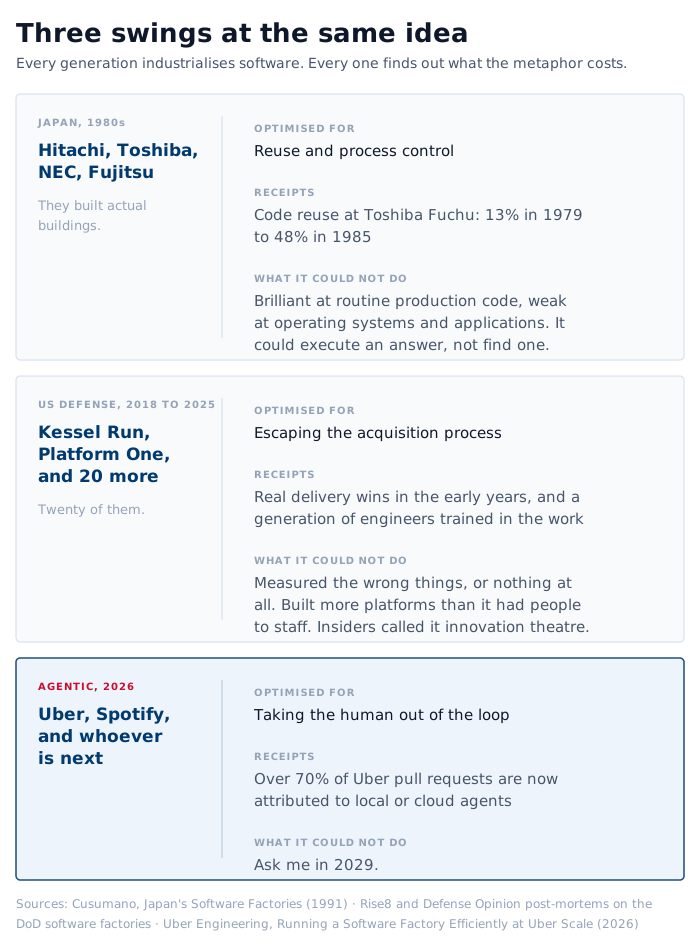
Software factories were tried in 1980s Japan and again across US Defense. Both fell short in the same way. The agentic version in 2026 is different in one specific respect, and it is not the agents.
Read